 中文
中文
 Español
 Francés
 Русский
 Português
 العربية
 Deutsch
 Italiano
 한국인
한국인
 Melayu
 ไทย
ไทย
 Việt
Việt
 bahasa Indonesia
 қазақ
қазақ
 Nederlands
 Ελληνικά
 Magyar
 čeština
 Suomalainen
 Filipino
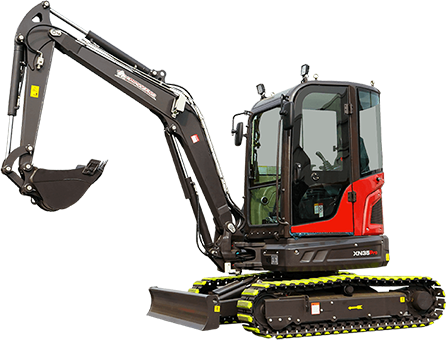
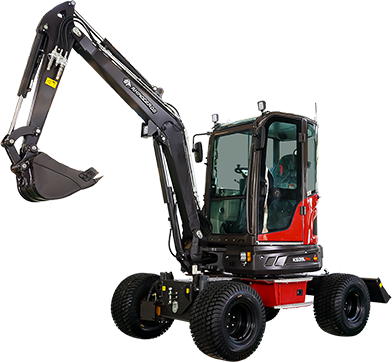
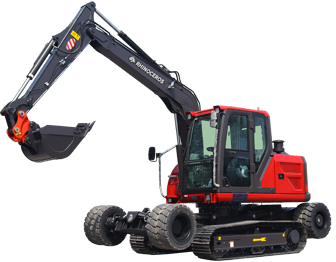
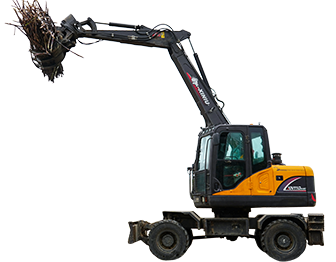
Compact Wheel Excavator Buying Guide: Everything to Check
Reviewed by Justin, Product Engineer·Based on official factory specifications and industry reporting, August 2026
TL;DR: A compact wheel excavator is one machine with a dozen real decisions attached to it, from tires to financing. This guide organizes all of them in one place.
Most wheel excavator research happens one question at a time: how does it stay stable, what tires should it run, is it worth financing. Each question has a real answer, but almost nobody sees how they connect until they're standing in front of a purchase decision with half the picture. This guide is the other half, organized so the connections are visible.
How it actually works
Start here if the basic mechanics still feel unclear. A wheel excavator doesn't stabilize through its tires the way a casual glance might suggest, and it solves a genuinely different problem than the machine it's most often confused with.
How Do Wheel Excavators Stay Stable Without Tracks? covers the outrigger-and-blade system that anchors the machine before digging starts, since the wheels themselves aren't doing that job.
Wheel Excavator vs Backhoe Loader clears up a genuinely common procurement mix-up, using real spec data across both machine types rather than general industry averages.
Can a Wheel Excavator Drive Itself Between Job Sites? explains the self-propelled road travel capability that's the category's core differentiator against crawler machines.
Setting it up right
Once the basics are clear, the next layer is configuration: what tires, what coupler system, and whether the standard setup actually fits the work.
Solid vs Pneumatic Tires on a Wheel Excavator walks through the puncture-resistance-versus-ride-comfort trade-off, plus the foam-filled middle option most buyers don't know exists.
Quick Coupler vs Manual Pin covers the actual payback math on hydraulic attachment swapping, since the answer depends entirely on how often attachments change, not on the feature itself.
What it costs to keep running
A purchase price is one number. Total cost of ownership is several more, and they don't all move in the same direction.
Wheel Excavator Total Cost of Ownership: Tires vs Tracks breaks down where wheels save money and where tracks still win, based on site mix rather than a blanket recommendation.
Wheel Excavator Maintenance: What's Actually Different From a Crawler Machine covers the undercarriage checklist that changes, tire pressure and bearings instead of track tension and sprockets.
Winter-Ready or Not? addresses the seasonal maintenance habit, a short warm-up cycle, that prevents most cold-climate startup failures.
Is Telematics on a Compact Wheel Excavator Real, or Just Marketing? separates genuine connectivity features from category-wide marketing language, particularly relevant at this size class.
Matching it to your fleet
The right machine for a demolition contractor isn't the right machine for a municipal utility crew, even at the same size class.
Wheel Excavators for Utility Crews covers why scattered, multi-stop workdays change the value calculation compared with single-site jobs.
Buying a Wheel Excavator from China walks through certification and road-compliance questions specific to importing a self-propelled machine.
Paying for it
The last layer is money: how to finance the purchase, and what the machine will realistically be worth when it's time to sell or trade it.
Financing a Wheel Excavator: Loan vs Lease vs Rent covers current 2026 rate ranges, what lenders actually check, and when renting still beats owning.
Wheel Excavator Resale Value: What Actually Drives Depreciation covers the five-year depreciation curve and the ownership habits that protect resale price beyond age alone.
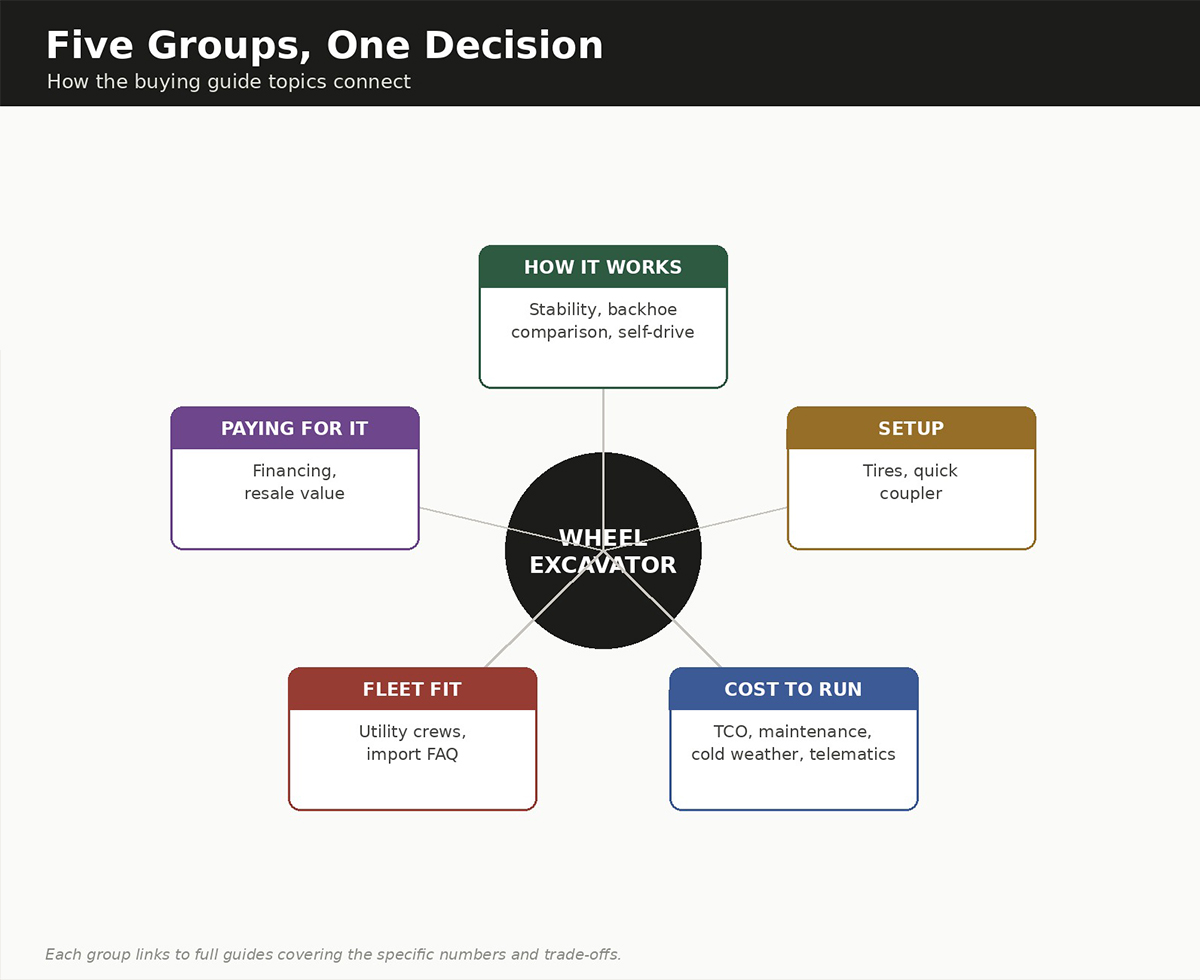
How these questions actually connect
None of the topics above sit in isolation, even though each reads as a standalone question. A tire choice affects total cost of ownership. Financing terms interact directly with the depreciation curve, a mismatch between the two is how an owner ends up owing more than the machine is worth. A fleet's job mix, utility crew versus demolition contractor, determines whether telematics is worth its cost and whether solid or pneumatic tires make more sense. Reading any one of these guides in isolation gets a buyer part of the way there. Reading them as a connected set is what actually produces a decision that holds up once the machine is on a job site.
A practical starting order
For a buyer starting from zero, working through this cluster in a specific order tends to save the most backtracking. Start with how the machine stabilizes and how it differs from a backhoe loader, since that settles whether a wheel excavator is even the right category. Move to tires and coupler setup once the category is confirmed. Then total cost of ownership and maintenance, since those numbers inform whether financing or cash purchase makes more sense. Finish with financing and resale planning, since those decisions are easiest to make once every other variable is already settled.
Frequently asked questions
Where should a first-time wheel excavator buyer actually start?
With the stability and backhoe loader comparison guides, since those settle whether the machine category itself is the right fit before any configuration questions matter.
Do these topics apply the same way to every wheel excavator size class?
The underlying principles generally do, but specific numbers, tire sizing, financing terms, depreciation curves, vary by machine size and should be confirmed against the specific model being considered.
Is it worth reading every guide before making a purchase decision?
Not necessarily all at once. The ones most relevant to a specific buyer depend on their job mix and financing situation, though the connections between them are worth understanding even when a specific guide doesn't apply directly.
How often does this guidance get updated?
Financing rates, depreciation benchmarks, and technology availability change over time; individual guides note their last update date, and current specifications should always be confirmed directly with Rhinoceros.
Does Rhinoceros offer every configuration discussed across these guides?
Configuration availability, tire type, coupler system, telematics, varies by model. Each linked guide notes where to confirm specifics directly with Rhinoceros rather than assuming universal availability.
What if my situation doesn't fit neatly into any single guide?
Most real purchase decisions combine factors from several of these guides at once, which is exactly why they're organized as a connected set rather than isolated articles.
This guide organizes existing Rhinoceros wheel excavator content by topic; individual linked articles contain their own sourcing and update dates. Confirm current specifications directly with Rhinoceros before purchase.