 中文
 Español
 Francés
 Русский
 Português
 العربية
 Deutsch
 Italiano
 한국인
 Melayu
 ไทย
 Việt
 bahasa Indonesia
 қазақ
 Nederlands
 Ελληνικά
 Magyar
 čeština
 Suomalainen
 Filipino
Solid vs Pneumatic Tires on a Wheel Excavator: Which Fits?
Reviewed by Justin, Product Engineer·Based on official factory specifications and industry reporting, August 2026
TL;DR: Solid tires never go flat, best for debris-heavy sites. Pneumatic tires ride smoother and don't damage soft ground, best for varied terrain. The choice depends on your worst-case job site.
A punctured tire on a demolition site isn't a minor inconvenience. It's a machine sitting idle while someone finds a replacement, on a job where every hour of downtime has a cost. That single risk is why the solid-versus-pneumatic tire decision matters more on a wheel excavator than it might seem from a spec sheet.
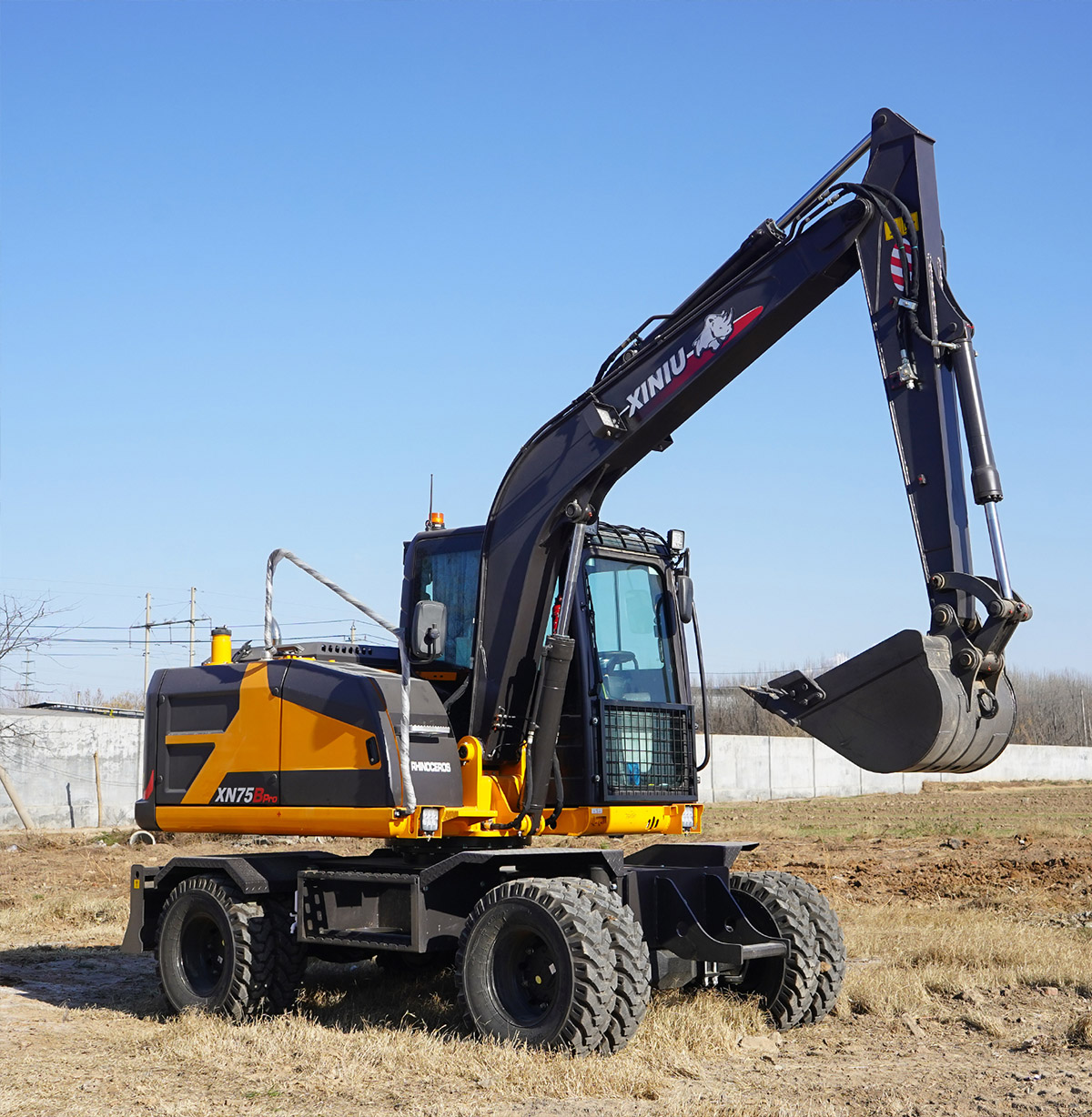
What actually separates the two tire types
Pneumatic tires are air-filled, built like a heavier-duty version of a standard vehicle tire, relying on internal air pressure to support the machine's weight and absorb shock from uneven ground. Solid tires are rubber through and through, no air, no tubes, no possibility of a flat, trading that puncture immunity for a firmer, less cushioned ride.
That single construction difference drives nearly every practical trade-off between the two, and it's worth understanding both sides before assuming one is simply "better" than the other.
Where solid tires win
Zero puncture risk
Solid tires eliminate the possibility of a flat entirely, which matters most on sites with sharp debris, metal fragments, broken concrete, or demolition waste, exactly the conditions most likely to puncture a pneumatic tire mid-job.
Consistent load capacity over time
A solid tire's load-bearing capacity doesn't depend on maintained air pressure, so it stays consistent throughout its service life without the periodic pressure checks pneumatic tires require. For a fleet operator managing multiple machines, that's one less maintenance item to track across every unit.
Lower long-term cost on high-cycle, debris-heavy work
While solid tires generally cost more upfront, the avoided downtime and repair cost from punctures can make them the lower total-cost option specifically on sites where pneumatic tires would otherwise fail often, which is why solid tires dominate in demolition and scrap-handling applications despite the higher initial price.
Where pneumatic tires win
Shock absorption and operator comfort
Pneumatic tires cushion the ride over uneven ground in a way a solid tire structurally cannot, since the air itself is doing the absorbing. On a job involving long hours over rough or varied terrain, that difference compounds into real operator fatigue over a full shift.
Reduced ground damage
A pneumatic tire's larger footprint and give distributes weight more gently across soft or finished ground than a solid tire's firmer contact patch, which matters directly on residential, landscaped, or turf-sensitive sites where surface damage has its own cost.
Better traction on loose or soft surfaces
The flex and tread design of a pneumatic tire generally grips loose or soft ground, gravel, sand, wet soil, more effectively than a solid tire's more rigid contact surface, which matters on sites where traction, not just puncture resistance, determines whether the machine can work efficiently at all.
Five questions that predict which side you're on
Does the job site regularly involve sharp debris, rebar, or broken concrete?
Is the ground soft, finished, or landscaped in a way that surface damage would matter?
Are shifts long enough that operator fatigue from ride comfort becomes a real factor?
How much does unplanned downtime actually cost on a typical job for this machine?
Is the machine dedicated to one job type, or does it move between varied site conditions?
A machine working demolition or scrap sites consistently leans solid. A machine working varied residential, landscaping, or utility sites with softer ground leans pneumatic. A machine genuinely splitting time between both conditions is where this decision gets harder, and where the next section matters most.
The middle option: foam-filled tires
Between solid and standard pneumatic sits a hybrid option: foam-filled pneumatic tires, which keep the pneumatic tire's shape and footprint but eliminate flat risk by filling the interior with foam instead of air. This split-the-difference approach gets genuine consideration from fleets that can't cleanly commit to one extreme or the other, trading some of pneumatic's cushioning for meaningfully reduced puncture risk compared with a standard air-filled tire.
Foam-filled tires typically cost more than standard pneumatic tires and can weigh more, which affects fuel efficiency and ride quality slightly, but for a machine that regularly encounters both debris risk and a need for reasonable ride comfort, they're worth evaluating as a genuine third option rather than defaulting straight to solid or pneumatic.
Cost comparison, beyond just the purchase price
Solid tires generally cost more to purchase upfront than an equivalent pneumatic tire, but the comparison shouldn't stop there. Pneumatic tires require periodic pressure checks and carry ongoing puncture repair risk, both of which add labor and downtime cost over the tire's life. Solid tires avoid both of those costs entirely but can transmit more shock to the machine's other components over time, which is worth factoring into a full cost picture rather than comparing sticker prices in isolation.
That same logic doesn't hold as clearly for a machine working primarily on clean, soft ground, where pneumatic's lower upfront cost and better ride quality tend to win the total-cost comparison instead.
What this means specifically for a compact wheel excavator
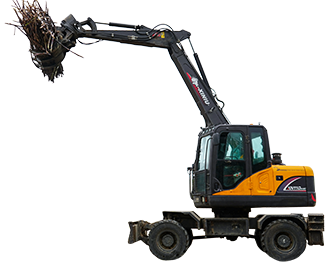
A compact wheel excavator's tire choice interacts with its overall stability and ground pressure characteristics covered elsewhere in evaluating this machine class. A solid tire's firmer, more consistent contact can support the more predictable stability a compact machine needs during full-reach digging, while a pneumatic tire's cushioning matters more during travel between sites than during the digging cycle itself, since outriggers and the dozer blade, not the tires, carry most of the stabilizing role once digging begins.
This means the tire decision for a wheel excavator specifically can lean more toward puncture resistance and consistent support than it might for other wheeled equipment where ride comfort during operation, not just during travel, is a bigger factor.
Retrofitting and switching tire types later
A machine purchased with one tire type isn't necessarily locked into that choice permanently. Many wheel excavators can be retrofitted with a different tire type later, solid to pneumatic or the reverse, though compatibility, cost, and whether the specific rim and axle configuration supports the swap varies by model. For a buyer uncertain about long-term site conditions, confirming retrofit compatibility upfront is worth doing before assuming the initial tire choice is permanent.
Confirm what ships standard before assuming
Standard tire type varies by manufacturer, model, and region, and it's not safe to assume a specific wheel excavator ships with either solid or pneumatic tires by default. Confirm directly with Rhinoceros which tire type is standard on the specific model and configuration being purchased, and what the cost and lead time look like for the alternative if the job's actual conditions call for a different type than the standard configuration.
A third data point worth citing: puncture resistance percentages
Industry-reported puncture resistance figures give a concrete sense of the gap between the two tire types. Solid tires can achieve puncture resistance approaching 95 percent compared with standard pneumatic tires in heavy-duty industrial applications, according to 2026 industrial solid tire performance analysis. That same analysis notes solid tires also tend to run cooler under sustained heavy use than pneumatic tires, since they don't rely on internal air pressure that can build heat under load, which contributes to a longer working life in continuous-duty applications specifically.
That figure is drawn from industrial and wheel-loader contexts rather than wheel excavators specifically, but the underlying mechanism, solid rubber simply can't be punctured the way an air-filled casing can, applies the same way regardless of machine type.
Tread pattern: a factor within each tire type, not just between them
Tire type isn't the only variable. Within either solid or pneumatic tires, tread pattern and rubber composition affect traction and service life meaningfully, and a poorly matched tread on the right tire type can still underperform a well-matched tread on the "wrong" one for a given site. A tire supplier who can speak specifically to tread pattern recommendations for the actual ground conditions being worked, not just tire type in the abstract, is worth the extra conversation before finalizing a purchase or replacement order.
How this decision interacts with warranty and service agreements
Tire type can affect warranty terms in ways that are easy to overlook. Some manufacturers structure machine warranties differently depending on whether standard or upgraded tire configurations are fitted, and aftermarket tire changes can, in some cases, affect coverage on tire-adjacent components like wheel bearings or hubs. Confirming how a tire type change interacts with any existing warranty, before making the switch rather than after, avoids an unpleasant surprise if a related component issue comes up later.
A realistic scenario, worked through
Consider a rental fleet running a compact wheel excavator across a mix of jobs: some weeks on clean landscaping sites, others on demolition cleanup with scattered rebar and broken masonry. Equipping that machine with standard pneumatic tires means accepting real puncture risk on the demolition weeks, potentially pulling the machine out of service mid-job for a tire repair. Equipping it with solid tires means accepting a firmer ride and slightly more ground disturbance on the landscaping weeks, where puncture risk was never really the concern in the first place.
This is precisely the split-use case where foam-filled tires earn genuine consideration, since the fleet doesn't have to choose one extreme and accept its downside on the weeks that don't match. For a fleet that can predict which job type will dominate over a tire's service life, matching the tire type to that dominant use case is usually simpler and more cost-effective than defaulting to the compromise option for every machine.
Seasonal and regional considerations
Climate affects this decision too, though less dramatically than site conditions do. Pneumatic tires can lose pressure faster in very cold temperatures, requiring more frequent pressure checks during winter months in colder regions, while solid tires are unaffected by temperature-driven pressure loss since there's no air pressure to begin with. This is a secondary factor compared with debris risk and ground sensitivity, but worth mentioning for a fleet operating in a region with significant seasonal temperature swings.
A simple way to decide
If unplanned downtime from a puncture would seriously disrupt a job, or the site regularly involves sharp debris, solid tires are the safer default even at a higher upfront cost. If ride comfort, traction on soft ground, or avoiding surface damage matter more than puncture risk, pneumatic tires remain the better fit. A machine genuinely working both conditions regularly is exactly the scenario foam-filled tires were developed to address, and it's worth evaluating that middle option directly rather than forcing a choice between the two extremes.
Frequently asked questions
Do solid tires wear out faster than pneumatic tires?
Not typically. Solid tires generally have a longer service life under heavy use since there's no air pressure to maintain or lose, though the firmer ride can transmit more wear to other machine components over time.
Are solid tires significantly heavier than pneumatic ones?
Yes, generally, which is worth factoring into overall machine weight and fuel efficiency calculations, though the difference is usually modest relative to the machine's total operating weight.
Can foam-filled tires be added to a machine that originally shipped with air-filled pneumatic tires?
Often yes, since foam-filling is typically done within the same tire casing rather than requiring a different tire entirely, but confirm compatibility with the specific tire model before assuming.
Is tire choice something I can change after purchasing the machine?
Often yes, depending on the model's rim and axle configuration, though it's worth confirming retrofit compatibility and cost with the manufacturer before purchase if there's genuine uncertainty about future site conditions.
Do solid tires affect a wheel excavator's stability during digging?
Generally in a positive direction, since a firmer, more consistent tire contact supports more predictable stability, though outriggers and the dozer blade do most of the actual stabilizing work during digging regardless of tire type.
What tire type does Rhinoceros use standard on its wheel excavator line?
Confirm current standard configuration and available alternatives directly with Rhinoceros for the specific model you're evaluating.
Tire type availability and specifications vary by model and configuration; confirm current specifications directly with Rhinoceros before purchase.