 中文
 Español
 Francés
 Русский
 Português
 العربية
 Deutsch
 Italiano
 한국인
 Melayu
 ไทย
 Việt
 bahasa Indonesia
 қазақ
 Nederlands
 Ελληνικά
 Magyar
 čeština
 Suomalainen
 Filipino
How does a stand-on loader stay safe when the operator has no cab?
How does a stand-on loader stay safe when the operator has no cab?
TL;DR: A stand-on loader trades the cab for layers: a stop lanyard, a parking cylinder, a wrap-around platform and a moulded handrail. Each covers one failure; none replaces safe operating practice.
The real spec this article explains
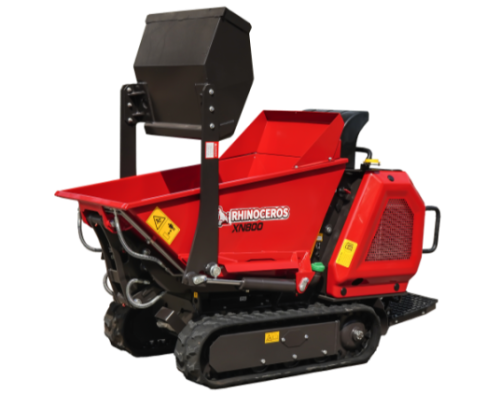
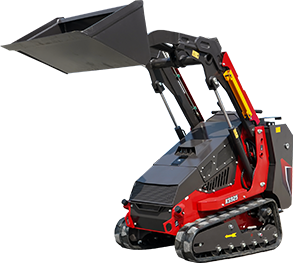
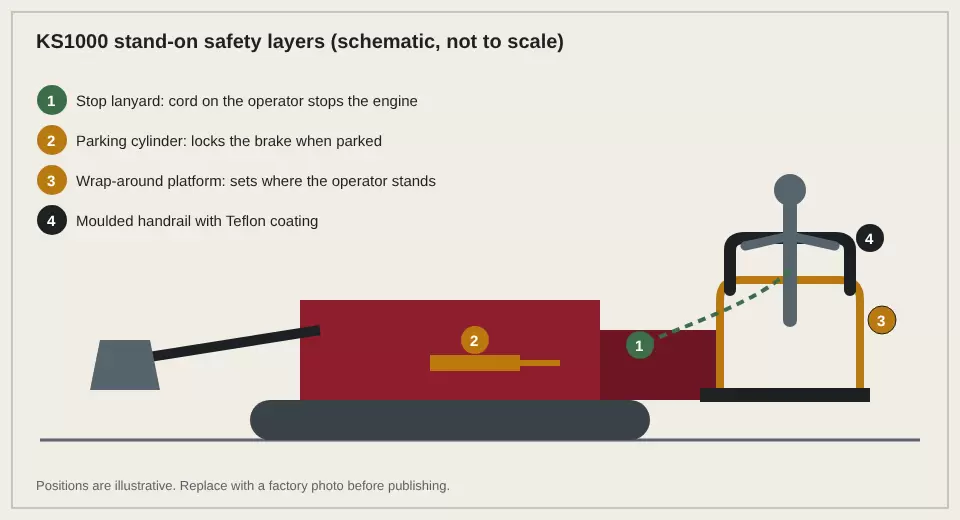
The KS1000 compact crawler loader is a stand-on machine: the operator rides on a platform at the rear instead of sitting in a cab. Its safety set, as we list it, is an engine stop lanyard (extra lanyards can be supplied), a parking cylinder, a wrap-around operator platform, and a handrail that is rotationally moulded with a Teflon coating. None of these is exotic on its own. The useful question is what each one is for.
What changes when you stand instead of sit
A seated operator is held in place by a seat, and many ride-on loaders tie machine functions to seat or bar position. A standing operator has none of that, so the design has to answer two plain questions: what happens if the operator falls or steps off, and what keeps the machine where it was left. Industry coverage of stand-on loaders notes that a foot pedal is commonly used as an operator-presence switch, with auxiliary circuits locked out when the operator steps off the platform (Equipment World). That is one approach. The KS1000 listing uses a different combination, covered below.
Layer 1: the stop lanyard
The lanyard is a cord that clips to the operator. If the operator falls away from the platform, the cord is pulled and the engine is shut off. It is simple, mechanical and cheap to inspect: you can see whether it is clipped on, and whether the cord is frayed. Its limit is just as simple. It only works if the operator wears it, which is why extra lanyards can be supplied.
Layer 2: the parking cylinder
A parking cylinder is the parking brake. When the machine is parked, the cylinder pushes the brake mechanism so the brake locks and the machine cannot roll. Depending on the hydraulic system design, the brake is released by the cylinder moving the other way. Parking brakes in this class of machine come in several designs. Caterpillar, for example, describes a spring-applied, hydraulically released parking brake on its skid steers (Caterpillar), so the exact mechanism is a design choice, not a standard.
| Situation | Without a locked brake | With the parking cylinder set |
|---|---|---|
| Parked on a slope or uneven ground | The machine can creep or roll | The brake is locked, which reduces the risk of unintended movement |
| Operator steps off | External force or slope can move the machine | The machine stays where it was left |
| Loading onto a trailer or working near people | An unintended roll becomes a crush hazard | The brake adds a mechanical hold between moves |
Layer 3: the wrap-around platform
On the KS1000 the operator stands inside a platform that wraps around the standing position rather than a flat plate open on three sides. The point of the surround is to define where the operator stands and to give the body a limit against sideways movement on uneven ground. It is a layout choice, so the right way to judge it is to stand on the machine and check reach to the controls, foot position and hand hold. A drawing cannot show that.
Layer 4: the moulded handrail
The handrail is rotationally moulded, which means it is formed as a single hollow plastic piece, so there are no welded seams or sharp joints on the part the operator grips, and the edges are rounded. It also carries a Teflon coating. A handrail is the part the operator holds when the platform moves on rough ground, so it is a contact point worth looking at in person.
What none of these layers replaces
The lanyard does not stop a machine that is already rolling in gear. The parking cylinder does not make a slope safe to work on. The platform and handrail do not make a fall harmless. They reduce specific risks, and they work together with the basics: lower the bucket, stop the engine, set the brake, then step off. Operating within the machine's rated limits is covered in our article on tipping capacity versus rated operating capacity.
Questions to ask any supplier of a stand-on loader
What stops the engine if the operator leaves the platform, and does it depend on the operator wearing something?
Is the parking brake applied by the operator, or automatically when the operator steps off?
Can I stand on the platform before buying and check reach, foot position and hand hold?
How often should the lanyard and brake be inspected, and where is that written down?
Which of these features are standard on the quoted configuration, and which are options?
Send us your configuration through the inquiry form if you want the exact setup for your order. Related KS1000 notes: what the anti-stop system prevents and the protection details on lines and cylinders. You can also compare it with the rest of the crawler loader range.
Frequently asked questions
Is a stand-on loader less safe than one with a cab?
They manage risk differently. A cab encloses the operator; a stand-on machine relies on layers such as a stop lanyard, a parking brake and a platform. The right choice depends on the work and the site.
What does the stop lanyard do on the KS1000?
It is a cord clipped to the operator that stops the engine if the operator moves away from the platform. Extra lanyards can be supplied.
What is a parking cylinder?
It is the parking brake actuator. It pushes the brake mechanism so the brake locks while the machine is parked, and releases it by cylinder action depending on the hydraulic design.
Does the parking cylinder make it safe to park on a slope?
It reduces the risk of unintended movement, but it does not make a slope safe. Park on firm, level ground where you can.
What is a rotationally moulded handrail?
A handrail formed as one hollow plastic piece, which avoids welded seams and sharp joints on the part the operator holds.
Does the KS1000 apply its brake automatically when I step off?
We list a parking cylinder and a stop lanyard. How the brake is applied on your configuration is something to confirm with us before purchase.
Feature availability varies by model and configuration; confirm current specifications directly with Rhinoceros before purchase. Industry sources describe how other manufacturers design stand-on safety and are not claims about the KS1000. This article does not replace the operator's manual or site safety rules.