 中文
中文
 Español
 Francés
 Русский
 Português
 العربية
 Deutsch
 Italiano
 한국인
한국인
 Melayu
 ไทย
ไทย
 Việt
Việt
 bahasa Indonesia
 қазақ
қазақ
 Nederlands
 Ελληνικά
 Magyar
 čeština
 Suomalainen
 Filipino
XN70L's Patented Double-Tire System: What It Solves
Reviewed by Justin, Product Engineer·Based on official factory specifications and industry reporting, September 2026
TL;DR: A wheel excavator's boom shifts its center of gravity forward the moment it digs. Dual tires widen the ground contact patch exactly where that shift matters most.
A second tire bolted next to the first looks like an easy spec to dismiss as overkill. On a wheel excavator specifically, it's solving a stability problem that's built into the machine's basic geometry, not adding weight for its own sake.
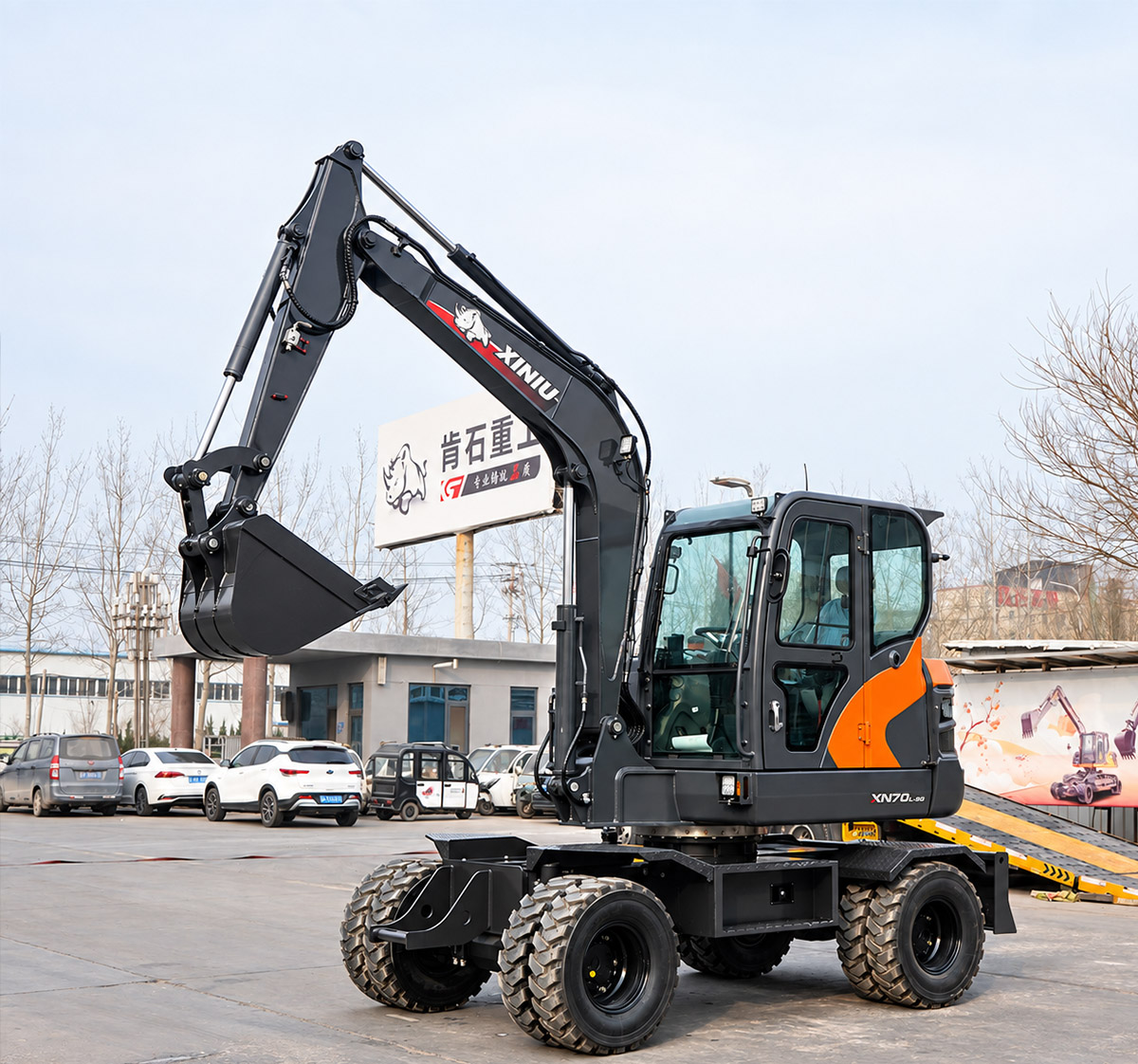
The problem dual tires actually address
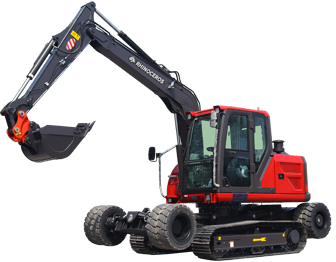
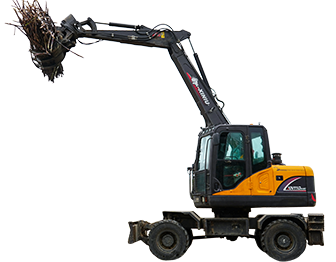
A wheel excavator's working arm extends forward and swings through a wide arc, which continuously shifts the machine's effective center of gravity away from where it sits at rest. This is a well-documented challenge across the wheel excavator category generally: the boom's overhang pulls the center of gravity forward during normal digging, and loading the bucket can shift it further still. Manufacturers have approached this problem in different ways, including various dual-tire and wide-tire configurations. The XN70L's specific patented approach, two complete tires mounted side by side on a single axle at each front wheel position, is Rhinoceros's own engineering solution to that challenge, not an implementation of any particular third-party patent.
The general mechanism is well established across heavy equipment more broadly: mounting two wheels side by side on the same axle increases the contact area and distributes machine weight over a larger surface, which reduces ground pressure and improves stability, according to dual wheel assembly engineering guidance. That same principle is why dual-wheel setups show up across loaders, telehandlers, and diggers, not just wheel excavators, according to dual-wheel system manufacturing specifications for construction and industrial equipment.
Why width matters more than it sounds like it should
Ground contact area is the mechanism behind why this works. A single tire concentrates the machine's weight onto one relatively narrow contact patch. A dual tire arrangement spreads that same weight across two contact patches side by side, which does two things at once: it lowers ground pressure at any single point, and it widens the effective footprint the machine balances on, precisely on the side where digging force and boom position put the most strain.
Industrial dual-tire assemblies built for heavy equipment are marketed on exactly this combination, increased stability and load capacity for handling heavy material, according to industrial dual-tire assembly specifications for excavation equipment. On the XN70L, this isn't a retrofit or an aftermarket kit bolted on after the fact. Factory photos of the machine show two complete tires mounted side by side at each front wheel position, built into the undercarriage from the ground up rather than added as an accessory.
What this changes on real ground, not just on paper
Reduced soil compaction, which matters directly on landscaped, agricultural, or turf-sensitive sites where a single narrow tire would leave deeper ruts under the same load
Better traction on soft or uneven ground, since two contact patches grip more total surface than one
A wider stability margin during full-arm digging, exactly when the boom's overhang is pulling the center of gravity furthest from center
None of these benefits show up as a headline spec the way digging depth or engine power does, which is part of why a dual-tire configuration is easy to overlook when comparing wheel excavators purely on a spec sheet.
The trade-off: what dual tires cost you
Two tires per position instead of one means more rubber to maintain, inspect, and eventually replace, and a wider overall track width that can matter on genuinely narrow sites. This isn't a reason to dismiss the feature, but it's a real trade-off worth weighing against the specific ground conditions a buyer actually works on. A contractor running mostly paved, firm sites gets less practical benefit from the added stability than one working soft agricultural ground or freshly graded fill.
Is this the same thing as solid versus pneumatic tire choice?
No, and it's worth being direct about the distinction, since the two get confused. Solid versus pneumatic is a question of tire construction, whether the tire is air-filled or solid rubber, covered in more depth for the broader wheel excavator lineup. Dual tires is a question of how many tires sit at each wheel position, independent of which construction type is used. A dual-tire setup can run either solid or pneumatic tires; the two decisions solve different problems and aren't substitutes for each other.
Where this fits in choosing between wheel excavator models
Rhinoceros's wheel excavator lineup spans multiple configurations, and the patented double-tire system is specific to the XN70L, not a feature shared across every model in the range. A buyer comparing the full lineup, covered in more detail in the broader wheel excavator buying guide, should weigh this specific feature against the ground conditions and stability needs of the actual job mix, rather than assuming every wheel excavator in the range handles a fully extended boom on soft ground the same way.
Why this detail rarely shows up in general wheel excavator content
Most comparisons in this category default to the specs that are easiest to put in a table: operating weight, digging depth, engine power. A patented undercarriage detail like a dual-tire system doesn't fit neatly into that format, and it requires understanding the underlying stability physics to explain why it matters, which is likely why it gets skipped over in favor of headline numbers that are simpler to compare at a glance.
That gap is exactly where a genuinely useful comparison should focus, since a buyer choosing between models based only on the easy-to-compare numbers can miss a feature that materially changes how a specific machine performs on their actual ground conditions.
Confirm current specifications for your specific application
Configuration availability and specific engineering details behind the patented double-tire system are specific to the XN70L model. Confirm current specifications, and whether this configuration fits a specific job's ground conditions and site width constraints, directly with Rhinoceros before ordering.
Frequently asked questions
Does a dual-tire setup make a wheel excavator significantly wider?
Yes, meaningfully, since two tires occupy more lateral space than one, which is worth checking against site access constraints before assuming it fits every job.
Can dual tires be retrofitted onto other wheel excavator models?
The patented configuration described here is specific to the XN70L; confirm with Rhinoceros whether retrofit options exist for other models in the lineup.
Does a dual-tire system reduce fuel efficiency?
It can slightly, due to added rolling resistance and weight, though this is generally a minor factor compared with the stability and ground-pressure benefits on suitable terrain.
Is a dual-tire configuration only useful on soft ground?
It provides the most noticeable benefit on soft, uneven, or load-sensitive ground; the practical advantage is smaller on firm, paved surfaces.
Does this feature replace the need for outriggers during digging?
No. Outriggers and the front blade remain the primary stabilizing system during digging, covered separately for the wheel excavator category generally; dual tires address a different part of the stability equation related to ground contact and weight distribution.
How does maintenance differ with dual tires versus a single tire per position?
There's simply more tire surface to inspect and eventually replace, though the maintenance tasks themselves, pressure checks or wear inspection, are the same as for a single tire.
Specifications reflect standard XN70L configurations and may vary by option package; confirm current specifications directly with Rhinoceros before purchase.