 中文
 Español
 Francés
 Русский
 Português
 العربية
 Deutsch
 Italiano
 한국인
 Melayu
 ไทย
 Việt
 bahasa Indonesia
 қазақ
 Nederlands
 Ελληνικά
 Magyar
 čeština
 Suomalainen
 Filipino
Is "prevent slippage" on the XN500E mechanical 4WD or electronic traction control?
By Justin, Product Engineer · Based on official factory specifications and industry reporting, September 2026
TL;DR: "Prevent slippage" on a four-wheel-drive machine can mean a mechanical system, an electronic one, or both together. They solve the same problem in different ways. Here is what each does, and what to ask before assuming which one you are getting.
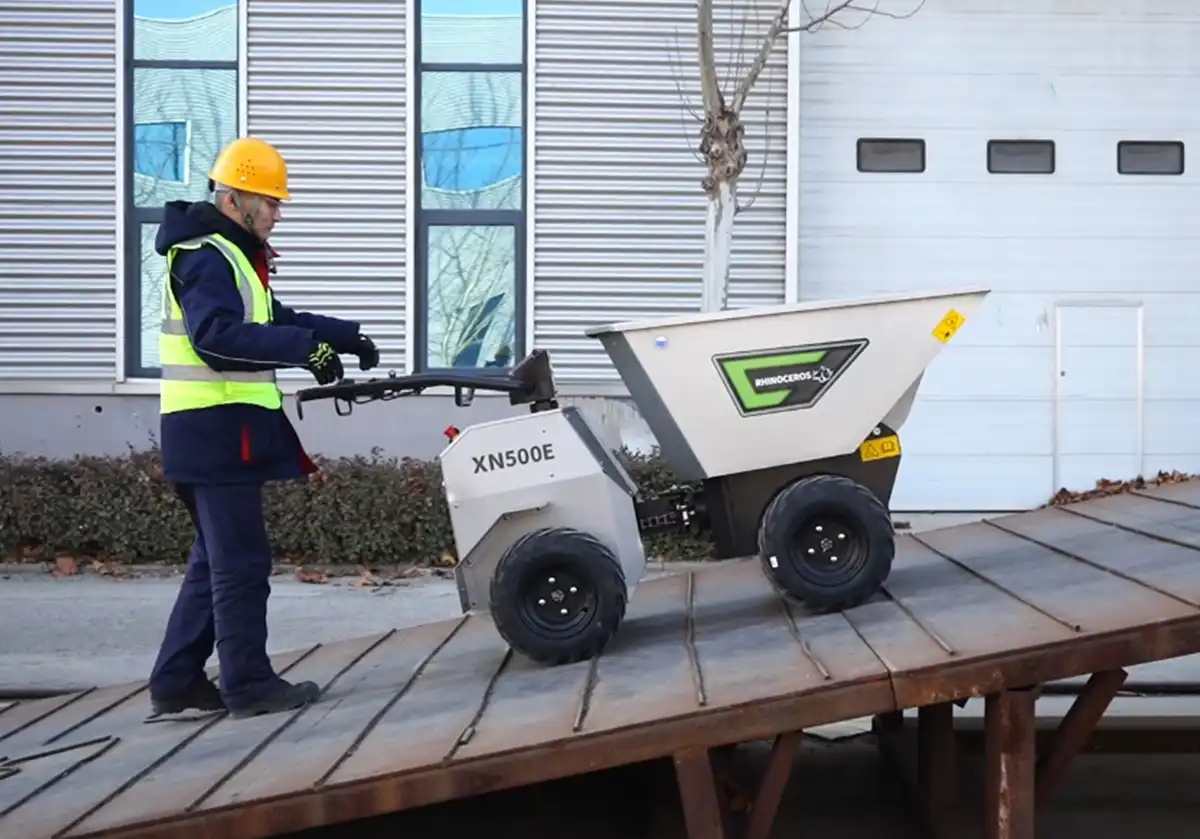
The real spec this article explains
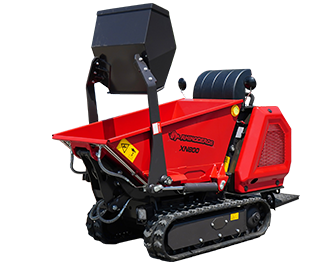
Our dumper range page lists the XN500E Electric Mini Dumper with a lithium battery, four-wheel drive, slip prevention, a compact design, and a working time of 4 to 6 hours. That line item, four-wheel drive with slip prevention, is a real feature on a real machine, not a phrase invented for this article. What it does not spell out is which of two established engineering approaches produces that result. Both are legitimate. They behave differently on the ground, which is the part worth understanding before you rely on either one.
Approach one: mechanical four-wheel drive
The traditional way to stop a wheel from spinning is entirely physical. A locking differential, or a drivetrain that sends power to all four wheels through gears and shafts, keeps torque going to the wheels that still have grip even when one wheel loses traction. One recent mechanical innovation in this space, unveiled at Agritechnica 2025 for steep-slope agricultural machinery, drives each wheel through its own planetary gearset so that even a wheel lifted off the ground keeps turning at the correct speed, without a differential or diff lock at all. Mechanical systems like this do not depend on sensors, software, or electronics to work. Their main limitation is that they generally react to slip after it starts, through mechanical resistance, rather than adjusting continuously before a wheel spins.
Approach two: electronic traction control
The newer, increasingly common way to solve the same problem uses sensors and software instead of, or alongside, mechanical linkages. Industry coverage of a 2026 electric commercial van describes its traction system monitoring wheel slip 50 times per second, cutting power to a slipping wheel and redirecting it to the wheels that still have grip, all through software rather than a physical differential. General explanations of traction control describe the same principle at a simpler level: the system detects a wheel spinning faster than the others and reduces power or applies light braking to that wheel until grip returns.
On an electric drivetrain like the XN500E's, this approach fits naturally, since each wheel can in principle be driven and monitored independently, without the mechanical linkages a diesel four-wheel-drive system would need.
Why the difference matters on site, not just on paper
| Mechanical 4WD | Electronic traction control | |
|---|---|---|
| How it responds | Physical linkage transfers torque to gripping wheels once slip occurs | Sensors detect slip and software adjusts power, often many times per second, sometimes before slip is visible |
| What can go wrong | Mechanical wear over time; some designs still allow brief wheel spin before engaging | Depends on sensor accuracy and software calibration; a fault can disable the assist even if the drivetrain itself is fine |
| What a real spec sheet should say | Type of differential or drive linkage | Sampling rate or response description, and whether it is adjustable for terrain |
| Typical service need | Mechanical inspection of gears, shafts, and locking mechanisms | Electronic diagnostics alongside mechanical checks |
What this means when you are comparing electric mini dumpers
Two listings can both say "four-wheel drive, prevent slippage" and mean different things underneath. Neither approach is automatically better. A mechanical system is simpler to service in the field and does not depend on electronics staying calibrated. An electronic system can react faster and finer, but only if the sensors and software are working correctly, and it adds a component that can fail independently of the drivetrain itself.
What matters for your site is less which category sounds more advanced, and more whether the actual ground you work on, wet grass, loose fill, a graded slope, is the kind of surface either approach is built to handle. If your job regularly starts loaded on a wet incline, ask specifically how the machine behaves in that exact condition, not just whether it is four-wheel drive.
Four questions to ask before you buy
Is slip prevention achieved mechanically, electronically, or both, on this specific model?
If electronic, how quickly does the system respond once a wheel starts to lose grip?
Does the system behave differently, or need adjusting, between wet grass, loose gravel, and a firm slope?
What does servicing the system involve if it needs attention, mechanical work, electronic diagnostics, or both?
Send us your typical ground conditions, load, and slope through our inquiry form, and we will confirm exactly how the XN500E's four-wheel drive and slip prevention are engineered, and whether that matches your site. You can review the full electric and diesel range on our mini dumper page.
Where this fits with the rest of our slope and stability guidance
This article is about grip, staying in contact with the ground without a wheel spinning. It is a different question from balance, whether a loaded machine can tip on a slope, which our tipping risk and load distribution guide covers. A machine can have excellent traction and still be at risk of tipping if loaded incorrectly, and the reverse is also true. Read both before you commit to a slope-heavy job.
Frequently asked questions
Is "prevent slippage" on the XN500E mechanical or electronic?
Our listing confirms four-wheel drive with slip prevention as a feature. Confirm the specific mechanism, mechanical, electronic, or both, directly with Rhinoceros for your exact configuration.
Is electronic traction control better than mechanical four-wheel drive?
Neither is universally better. Mechanical systems are simpler to service and do not depend on electronics. Electronic systems can react faster but depend on sensors and software working correctly.
Does four-wheel drive alone prevent a machine from slipping?
Not by itself. Four-wheel drive sends power to all wheels; slip prevention is the additional mechanism, mechanical or electronic, that responds when one wheel starts to lose grip.
Does slip prevention also stop the machine from tipping over?
No. Traction and tipping are different problems. Traction concerns grip on the surface. Tipping concerns balance under load on a slope. Both matter on sloped ground, separately.
Will slip prevention behave the same on wet grass as on loose gravel?
Not necessarily. Ask how the specific system performs across the surfaces your job actually involves, rather than assuming one rating covers every condition.
Does an electronic traction system need special maintenance?
It can require electronic diagnostics in addition to normal mechanical service. Ask what servicing the system involves before you buy.
Feature availability varies by model, configuration, and market; confirm current specifications directly with Rhinoceros before purchase. Third-party product and technology examples are cited for general explanation and are not claims about Rhinoceros products.