 中文
 Español
 Francés
 Русский
 Português
 العربية
 Deutsch
 Italiano
 한국인
 Melayu
 ไทย
 Việt
 bahasa Indonesia
 қазақ
 Nederlands
 Ελληνικά
 Magyar
 čeština
 Suomalainen
 Filipino
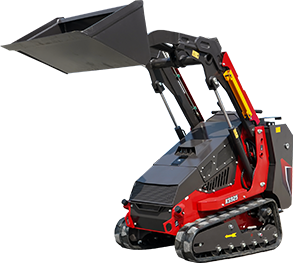
KS1000 service points: where every filter, dipstick, and fuse is
KS1000 service points: where every filter, dipstick, and fuse is
The cost of owning a loader is mostly time and habit. A machine whose checks are easy to find gets checked. Here is where each service point on the KS1000 sits, and what it protects.
Why a service map is worth having
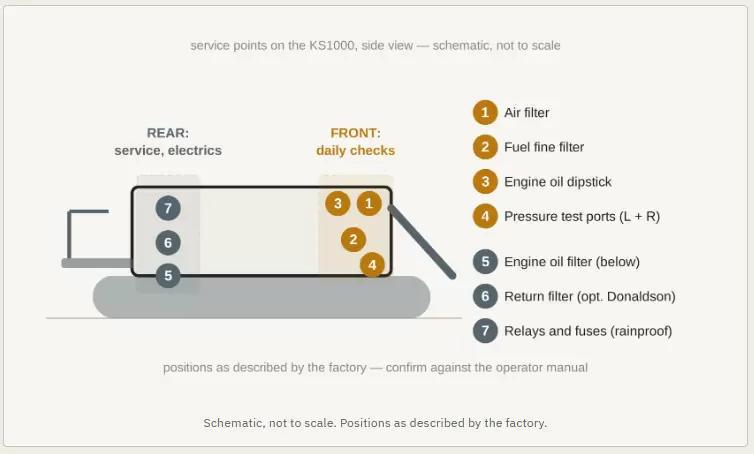
Checks that are awkward to reach tend to be skipped, and skipped checks are what turn a small problem into a repair. A loader that puts its everyday checks in one place, and its less frequent jobs in another, makes the right routine the easy one. This article lists where each point is on our KS1000 compact crawler loader, as described by the factory. It does not list service intervals, which belong in the operator manual for your machine.
The service points
| # | Service point | Location | What it does |
|---|---|---|---|
| 1 | Air filter | Front | Keeps dust out of the engine's intake air |
| 2 | Fuel fine filter | Front | Catches fine particles before fuel reaches the injection system |
| 3 | Engine oil dipstick | Front | Daily oil level check |
| 4 | Pressure test ports | Front, one left and one right | Lets a technician connect a gauge and read pressure |
| 5 | Engine oil filter | Rear, underneath | Filters engine oil at each oil service |
| 6 | Return filter | Rear, Donaldson element optional | Catches wear particles before hydraulic oil returns to the tank |
| 7 | Relays and fuses | Rear, top, rain-protected | Electrical protection and switching |
The front: where the daily checks are
The air filter, fuel fine filter, and engine oil dipstick are grouped at the front. That grouping matters because these are the items an operator is most likely to look at before starting work. The dipstick is the quickest check there is, and the air and fuel filters are the two that protect the engine from the outside world, dust in the intake and particles in the fuel.
The rear: service and electrics
The engine oil filter sits at the rear, underneath, so the oil service is done from the back of the machine. Also at the rear, on top, are the relays and fuses, in a rain-protected location chosen so that electrical faults can be reached without removing other parts. Fuses and relays are usually the first thing to check when something electrical stops working, so being able to open the box in the rain without water getting in is a practical detail.
The return filter, and why oil cleanliness matters
Hydraulic guides describe the job of a return filter plainly: it removes wear particles and dirt from the oil on its way back to the tank, so they do not circulate again and wear pumps, valves, and cylinders. On the KS1000 the return filter is at the rear, and a Donaldson element is available as an option.
This is closely tied to the travel drive. Radial piston motors are generally more demanding about oil cleanliness than simpler designs, as we explain in our note on radial piston travel motors, so clean oil and timely filter changes are where an owner protects that investment.
The pressure test ports
A pressure test port lets a technician connect a gauge and read pressure directly, instead of cutting into a line, which makes it quicker to tell whether a slow or weak function is a pressure problem. The KS1000 has one at the front left and one at the front right of the engine bay. Ask us which circuit each port reads, and what the correct readings are, so a service technician has a reference.
Questions to ask about any loader's serviceability
Where is each filter, and can it be changed without removing other parts?
Are daily checks grouped together where the operator can see them?
Are the fuses and relays protected from rain?
Are there test ports, and are the correct pressures documented?
Send us your service questions through our inquiry form and we can confirm the layout for your configuration. You can review the full specification on the KS1000 product page.
Frequently asked questions
Where is the engine oil dipstick on the KS1000?
At the front, together with the air filter and fuel fine filter.
Where are the fuses and relays?
At the rear, on top, in a rain-protected location.
Where is the engine oil filter?
At the rear, underneath the machine.
Does the KS1000 have a return filter?
Yes, at the rear. A Donaldson element is available as an option.
What are the pressure test ports for?
They let a technician connect a gauge and read pressure without cutting into a line. There is one at the front left and one at the front right.
How often should the filters be changed?
Follow the operator manual for your machine. Intervals depend on the engine and configuration and are not listed here.
Feature availability and locations vary by configuration; confirm current specifications and service procedures directly with Rhinoceros before purchase. Return filter function is described from published hydraulic filtration guides.