 中文
 Español
 Francés
 Русский
 Português
 العربية
 Deutsch
 Italiano
 한국인
 Melayu
 ไทย
 Việt
 bahasa Indonesia
 қазақ
 Nederlands
 Ελληνικά
 Magyar
 čeština
 Suomalainen
 Filipino
Radial piston vs cycloidal travel motors: what the difference means
Radial piston vs cycloidal travel motors: what the difference means
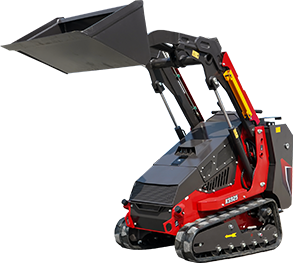
The KS1000 drives its tracks with radial piston motors and a closed-circuit piston pump. Here is how that compares with cycloidal motors on pressure, leakage, and low-speed control, and what it costs.
The real spec this article explains
Our KS1000 compact crawler loader is a hydrostatic machine with two-speed travel. Its tracks are driven by Hengli radial piston motors, working with a closed-circuit piston pump from Taifeng. The motor type is rarely written on a spec sheet, yet it decides how smoothly the pump's power becomes track movement.
What a travel motor does on a loader like this
A hydrostatic loader has no gearbox. The pump sends oil to a hydraulic motor at each track, and the motor turns it into rotation. Pump and motor together set how precisely the machine can creep, how it holds speed on a slope, and how much of the engine's power reaches the ground as heat instead of motion. This is the same drivetrain that our note on the anti-stall system protects.
Two motor families
Cycloidal motors, also called orbital, gerotor, or geroler motors, use a rotating inner gear set inside an outer ring. They are compact and inexpensive, deliver good torque at low speed, and are widely used in compact equipment. Radial piston motors place pistons around a central cam or crankshaft, and oil pressure on the pistons turns the output. They are larger and costlier, but they are the usual choice where high pressure, high torque, and fine low-speed control are needed.
Where radial piston motors differ
1. Higher pressure capability
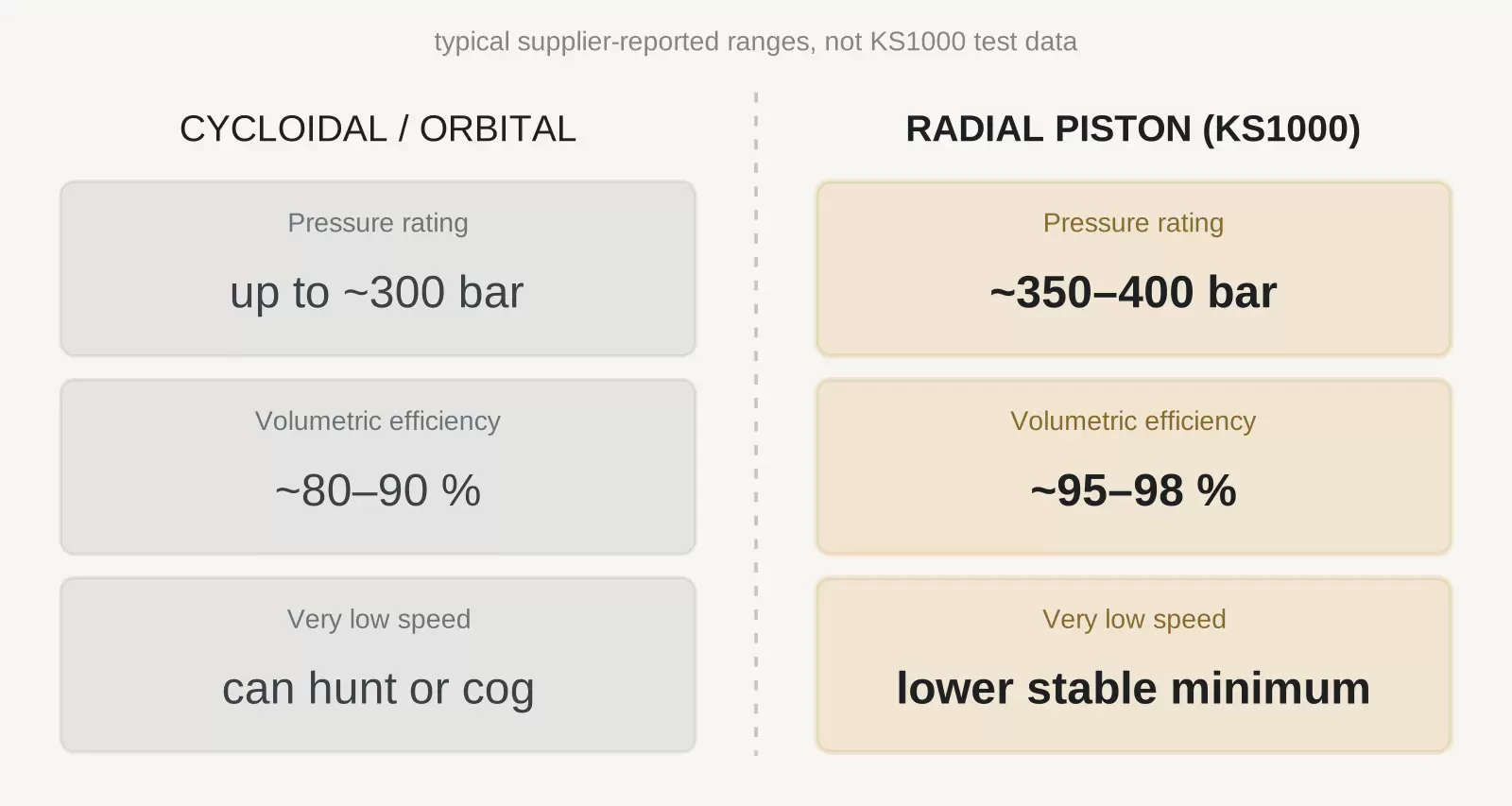
Supplier selection guides commonly put orbital motors at up to roughly 300 bar, while radial piston motors are listed in a range of roughly 350 to 400 bar. Higher pressure capability means the same motor can produce more torque, so a given torque can come from a smaller flow of oil.
2. Less internal leakage
Volumetric efficiency describes how much of the oil sent to the motor does useful work instead of leaking past internal clearances. Guides from motor suppliers report roughly 80 to 90 percent for gerotor-type motors and roughly 95 to 98 percent for radial piston motors. Patent literature on gerotor motors describes the underlying reason: their leakage paths grow as pressure rises, so efficiency falls under load. Less leakage means more of the pump's flow becomes track speed, less speed is lost when the machine is working hard, and less energy turns into heat in the oil.
3. Steadier at very low speed
Loader work is full of slow movements: inching a loaded bucket forward, creeping up a ramp, lining up with a trailer. Suppliers describe cycloidal motors as prone to hunting or uneven rotation at very low speeds, while radial piston motors are specified with a lower minimum stable speed. This is where an operator would feel the difference as smoother, more controllable slow travel.
Side by side
| Radial piston (KS1000) | Cycloidal / orbital | |
|---|---|---|
| Typical pressure rating | About 350–400 bar | Up to about 300 bar |
| Volumetric efficiency | About 95–98% | About 80–90% |
| Very low speed | Lower stable minimum | Can hunt or cog |
| Cost and size | Higher cost, larger | Lower cost, compact |
| Oil cleanliness | More demanding | More forgiving |
What this trades away
Radial piston motors cost more, and piston designs tolerate dirty oil less well than cycloidal designs, which is why filtration and regular filter changes matter more. Choosing them is a decision to spend on the drivetrain, and an owner who skips hydraulic oil and filter service gives part of that benefit back.
What this does not mean
The figures above are typical supplier ranges for each motor family, not measurements of the KS1000, and we have not published a tested efficiency for the machine. The motor is one part of the travel system. Pump, relief settings, track condition, and operator technique also shape how the machine drives.
Questions to ask before you compare loaders
What type of travel motor does the loader use, and from which maker?
Is the travel circuit closed-loop with a piston pump, or an open circuit with a gear pump?
How is two-speed travel achieved, and what is the top speed in each range?
What hydraulic oil and filtration does the manufacturer specify, and at what intervals?
Ask us for the confirmed drivetrain specification for your configuration through our inquiry form. You can review the full specification on the KS1000 product page.
Frequently asked questions
What kind of travel motors does the KS1000 use?
Hengli radial piston motors, working with a closed-circuit piston pump.
How is a radial piston motor different from a cycloidal motor?
Pistons arranged around a central cam turn the output in a radial piston motor, while a cycloidal motor uses a rotating gear set. Radial piston motors generally handle higher pressure and leak less.
Do radial piston motors give smoother slow driving?
Generally yes. Suppliers specify a lower stable minimum speed for them, while cycloidal motors can hunt at very low speeds.
Do they last longer?
They are often described that way, but life depends mostly on pressure, duty cycle, and oil cleanliness, so it is not guaranteed.
Is there a downside?
Cost and size are higher, and piston designs need cleaner oil, so timely oil and filter changes matter.
Does the KS1000 have two-speed travel?
Yes. Our listing shows high and low travel speed, with a maximum of 6.5 km/h.
Feature availability varies by model and configuration; confirm current specifications directly with Rhinoceros before purchase. Motor comparisons describe typical ranges from published supplier guides and patent literature, not measurements of the KS1000.