 中文
 Español
 Francés
 Русский
 Português
 العربية
 Deutsch
 Italiano
 한국인
 Melayu
 ไทย
 Việt
 bahasa Indonesia
 қазақ
 Nederlands
 Ελληνικά
 Magyar
 čeština
 Suomalainen
 Filipino
Greasable vs sealed track rollers: which is less work to own?
Greasable vs sealed track rollers: which is less work to own?
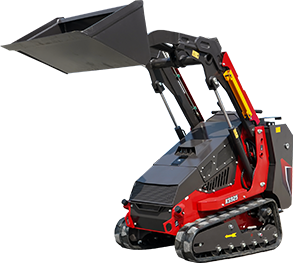
The KS1000 has greasable track rollers and a track tension indicator. Some rivals, such as the Bobcat MT100, use sealed rollers that need no daily roller maintenance. Here is what each choice asks of an owner.
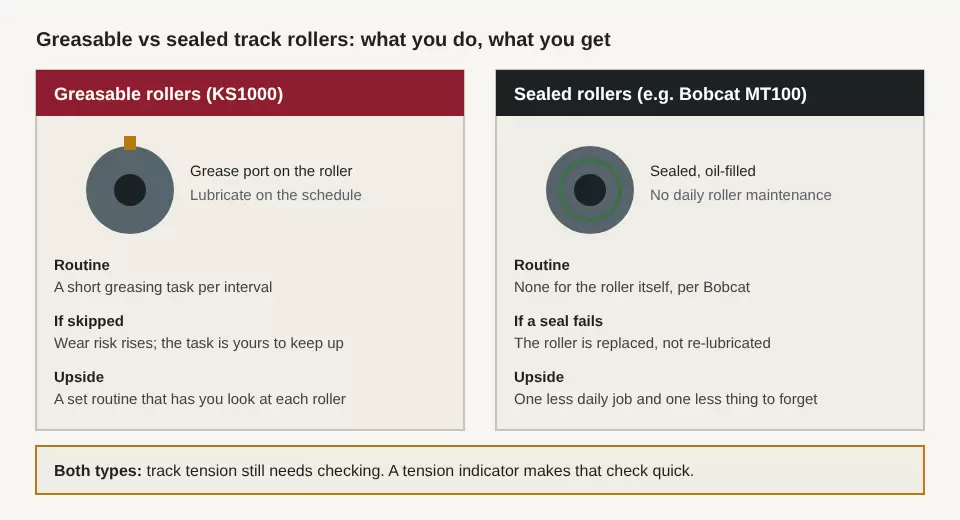
The real spec this article explains
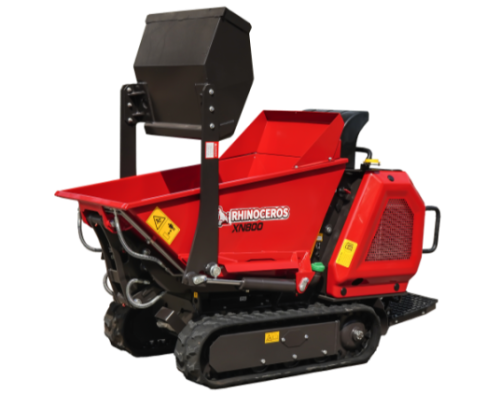
Our KS1000 compact crawler loader has track rollers fitted with grease ports, and a track tension indicator. The Bobcat MT100, a machine buyers often compare it with, uses permanently sealed rollers. Bobcat describes them as permanently sealed and constantly bathed in oil, and says the undercarriage needs no daily maintenance (Bobcat). Both are legitimate designs. They ask different things of the person who owns the machine.
What a track roller does, and why lubrication matters
Track rollers carry the machine's weight along the track and keep the track on its path. They turn constantly while the machine travels, so the bearing inside each roller is working whenever the tracks move. How that bearing is lubricated is the whole difference between the two designs.
Option 1: sealed rollers
A sealed roller holds its own oil and is closed for life, so there is nothing to grease. This is the appeal: one less daily job, and one less thing that can be forgotten on a busy site. The trade is on the other end. When a seal eventually fails, the roller cannot be topped up in the field. Parts guides for tracked machinery advise replacing a leaking or seized roller promptly, because a roller that stops turning can wear the track chain quickly (Wirtgen parts guide). The same guide notes that a small amount of oil weeping from a roller seal is normal and is different from a real leak, which is worth knowing before you condemn a roller.
Option 2: greasable rollers
A greasable roller has a grease port, so the owner can add lubricant on a schedule. The upside is control: lubrication is something you do, not something you hope for. A routine also means someone looks at each roller at each service. The downside is the mirror image of the sealed roller's strength. The task has to be done, on time, every time. If it is skipped, the risk of wear rises, and no design feature can cover for that.
Side by side
| Greasable (KS1000) | Sealed (e.g. MT100) | |
|---|---|---|
| Routine work on the roller | Grease on the maintenance schedule | None daily, per Bobcat |
| If the routine is skipped | Wear risk rises | Not applicable |
| Lubrication control | In the owner's hands | Fixed at the factory |
| When the bearing eventually fails | Roller is replaced; ask us for the part price | Roller is replaced; ask the maker for the part price |
| Track tension check | Still needed; indicator makes it quick | Still needed |
Track tension: the check that applies to both
Sealed or greasable, the rollers sit inside a track that must be held at the right tension. Bobcat's own undercarriage guidance says incorrect tension may lead to increased track wear, and suggests running tracks slightly looser in soft, muddy or sandy conditions (Bobcat undercarriage tips). Another undercarriage guide advises checking tension before using the machine each day, since proper tension extends track life and reduces the chance of the track coming off (Compact Equipment).
This is where the KS1000's tension indicator helps. It is meant to turn a tension check into a quick look, instead of a measurement you are tempted to skip. Adjust tension as the operator's manual instructs.
Which suits whom
If your machines are rented out, run by seasonal crews, or serviced rarely, a sealed roller removes a task that is easy to miss. If one person looks after the machine and runs a regular service, a greasable roller gives that person control over lubrication and a reason to inspect every roller. The honest answer is that the better design is the one whose routine you will keep.
What this does not mean
We have not tested the two designs against each other, and this article does not rank them. Statements about the Bobcat MT100 come from Bobcat's published descriptions. Which rollers on the KS1000 carry grease ports, and the greasing interval and grease type, are specified in the operator's manual and are available on request.
Questions to ask before you compare loaders
Are the track rollers sealed for life or greasable, and which rollers does that apply to?
What grease and what interval does the manufacturer specify, and how long does the job take?
What does a replacement roller cost, and is it stocked?
How is track tension checked and adjusted, and is there an indicator?
What roller wear limits does the manual give?
Ask us for the confirmed undercarriage specification for your configuration through our inquiry form. Routine service points are covered on our service points map, and the full specification is on the KS1000 product page.
Frequently asked questions
Does the KS1000 have sealed rollers?
Our listing shows track rollers with grease ports, so they are designed to be lubricated on a schedule rather than sealed for life.
Do sealed rollers need no maintenance at all?
Bobcat says the MT100 needs no daily roller maintenance. Track tension and a general undercarriage inspection are still part of owning any tracked machine.
Which is better, greasable or sealed?
Neither by default. Sealed removes a routine job; greasable keeps the job but gives the owner control. The better one is the one whose routine you will keep.
What does the track tension indicator do?
It lets you check whether track tension is in range with a quick look. Adjust tension as the operator's manual instructs.
Why does track tension matter?
Bobcat's guidance says incorrect tension may increase track wear, and another undercarriage guide says proper tension reduces the chance of the track coming off.
Is a small oil weep from a sealed roller a failure?
Not necessarily. A parts guide for tracked machinery says a small amount of oil weeping from a roller seal is normal, and is different from a real leak.
Feature availability varies by model and configuration; confirm current specifications directly with Rhinoceros before purchase. Statements about other manufacturers' machines are drawn from their published descriptions and general undercarriage guides, not from testing by Rhinoceros.