 中文
 Español
 Francés
 Русский
 Português
 العربية
 Deutsch
 Italiano
 한국인
 Melayu
 ไทย
 Việt
 bahasa Indonesia
 қазақ
 Nederlands
 Ελληνικά
 Magyar
 čeština
 Suomalainen
 Filipino
The tilting cab: service access, and why the safety bar matters
The tilting cab: service access, and why the safety bar matters
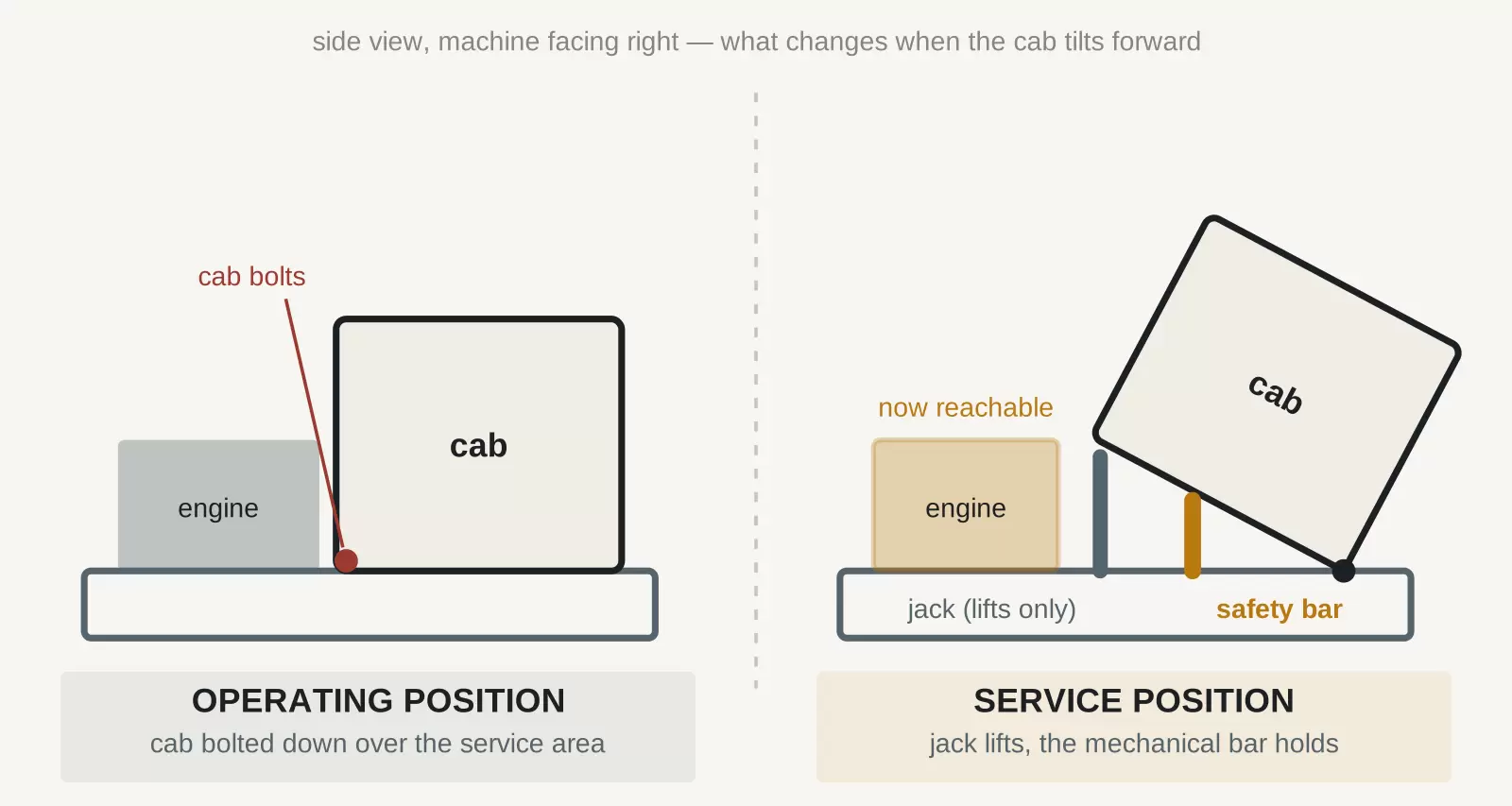
An independent dealer review of this machine singled out a cab that tilts forward for major engine service, held by a separate mechanical safety bar. Here is how that works and why the bar is the important part.
Where this detail comes from
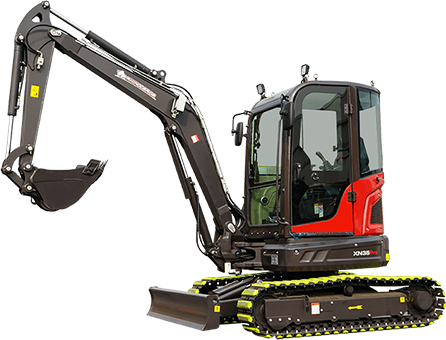
A tilting cab is not a bullet point on our XN35PRO spec sheet. It comes from an independent dealer, Parsons Link Equipment, whose hands-on walkaround reviewed this machine under the name RH40, the same excavator we sell as the XN35PRO. The reviewer noticed what looked like a rotation device at the cab, explained that the entire cab rotates forward, and described the procedure. They did not carry out a full tilt on camera, so treat the steps below as a described walkthrough of one unit. Confirm the details in the operator manual for your configuration.
Why an excavator cab tilts at all
The cab sits over components that need attention during a major service: the engine, pumps, and valves under the floor. A tilting cab gives access without lifting the cab off with a crane. This is an established design on compact machinery. For example, John Deere documents a tilt-up cab on its 26 P-Tier compact excavator, using a tilt tool to raise the cab forward up to 50 degrees for access to components under the floor. So the idea is not new. What the reviewer found notable was seeing it at this price level.
How the reviewer described the procedure
Remove the cab bolts. The reviewer pointed to bolts inside the cab, by the seat, and believed two need to come out.
Connect the jack. A bar stored inside the cab is used with a built-in hydraulic jack system at the rear.
Raise the rear of the cab. The reviewer said you flip a valve and jack the whole back of the cab up, and was not certain of that step.
Fit the safety bar. Once the cab is up, a bar is placed on the cylinders underneath, to keep anyone working under the cab protected.
The reviewer also noted that the instructions for tilting the cab are on a simple, easy-to-read English notice.
Why the safety bar is the important part
This is an engineering principle, not a preference. Cab tilt system manufacturers state it directly in their service documentation: a hydraulic cab tilt system is a cab lifting device, not a cab holding device, and anyone working under a raised cab should always engage the mechanical cab holding device. A hydraulic jack can leak down or be released, so the weight should never depend on it while a person is underneath.
What the reviewer described, a jack to lift and a separate bar placed on the cylinders to hold, is the arrangement that principle calls for.
What it means for an owner
Major service is more accessible. The components under the cab can be reached without removing the cab.
The safe way to work is built in. A dedicated bar makes the right procedure the easy one.
Routine checks are separate. The reviewer also pointed out a remote engine oil filter, so you are not hunting around the engine for it, with the oil fill and dipstick close by. Tilting the cab is for major service, not daily checks.
| Part | Job | Safe to work under? |
|---|---|---|
| Hydraulic jack | Lifts the cab to the service position | No, never rely on it alone |
| Mechanical safety bar | Holds the raised cab in place | Yes, once engaged |
| Cab bolts | Secure the cab in the operating position | Removed before tilting |
What this does not mean
A tilting cab does not replace routine maintenance access, and it does not make working under a raised cab safe without the mechanical bar. Follow the operator manual for the exact procedure, machine position, and any steps the reviewer did not demonstrate.
Questions to ask before you buy
Is the tilting cab fitted as standard on my configuration?
How many cab bolts are removed, and what tools does the procedure need?
Is the jack manual or powered, and where are the jack bar and the safety bar stored?
How far does the cab tilt, and is the procedure in the operator manual and on a machine decal?
Send us your service plans through our inquiry form and we can confirm how the XN35PRO's tilting cab works. You can review the full specification on the XN35PRO product page.
Frequently asked questions
Does the XN35PRO's cab tilt forward?
An independent dealer review of this machine, under the name RH40, described a cab that rotates forward for major engine service. Confirm it is fitted to your configuration.
Why is there a separate safety bar if there is already a hydraulic jack?
A hydraulic cab tilt system is a lifting device, not a holding device. A mechanical bar holds the cab so nobody works under weight supported only by hydraulics.
Is a tilting cab unique to the XN35PRO?
No. Major makers such as John Deere document tilt-up cabs on compact excavators. The reviewer's point was that it is uncommon at this price level.
How do you tilt the cab?
As described by the reviewer: remove the cab bolts, use the in-cab bar with the built-in hydraulic jack to raise the rear of the cab, then place the safety bar on the cylinders. Follow the operator manual for the exact steps.
Do I need to tilt the cab for routine checks?
No. It is for major service. The reviewer noted a remote engine oil filter, oil fill, and dipstick that are easy to reach for routine work.
Did the reviewer actually tilt the cab on camera?
No. The reviewer explained how it functions and showed the components, but did not demonstrate a full tilt, so confirm the procedure in the operator manual.
Feature availability varies by model and configuration; confirm current specifications and service procedures directly with Rhinoceros before purchase. The independent review described reflects one dealer's observations and is not a claim by Rhinoceros. Cab tilt safety principles come from published manufacturer service documentation.