 中文
 Español
 Francés
 Русский
 Português
 العربية
 Deutsch
 Italiano
 한국인
 Melayu
 ไทย
 Việt
 bahasa Indonesia
 қазақ
 Nederlands
 Ελληνικά
 Magyar
 čeština
 Suomalainen
 Filipino
What Is a Self-Loading Mini Dumper, and Do You Need One?
Reviewed by Justin, Product Engineer·Based on official factory specifications and industry reporting, August 2026
TL;DR: A self-loading mini dumper has a built-in loading arm, so one operator can gather, haul, and dump material without a separate loader. It costs more and trades off some payload for that convenience.
Search for mini dumpers right now and self-loading models dominate the results. That's not a coincidence. It's one of the fastest-growing segments in compact equipment, and it's worth understanding what the feature actually does before assuming it's the right fit.
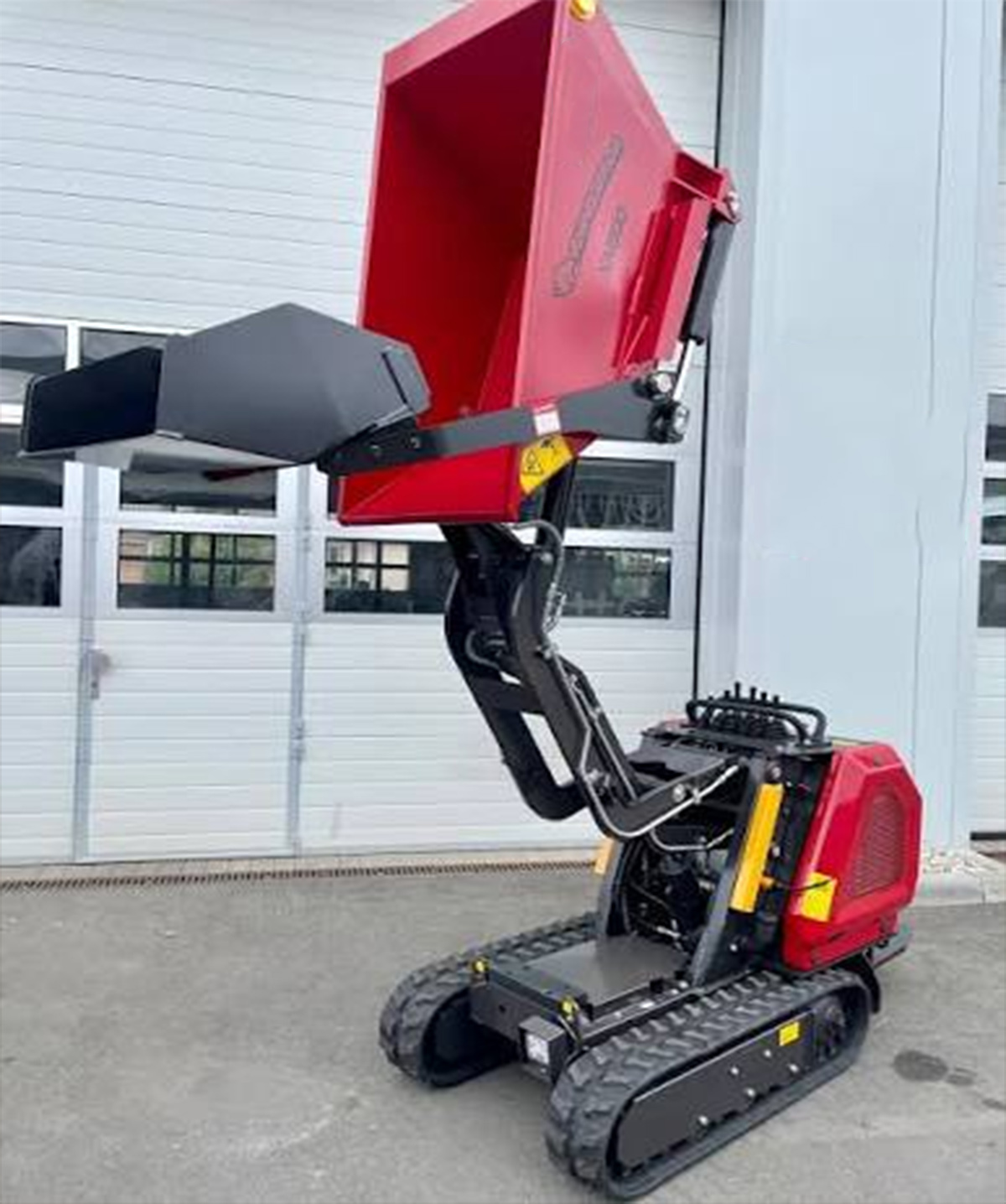
What "self-loading" actually means mechanically
A standard mini dumper has a tipping bucket or skip and nothing else. Something else, a shovel, a loader, or a mini excavator, has to fill it. A self-loading mini dumper adds a hydraulic loading arm to the front or side of the machine, similar in principle to a small excavator arm, so the same machine can scoop material and load its own bed without a second piece of equipment or a second person.
That single change is the entire value proposition. Everything else about a self-loading model, the tracks or wheels, the tipping mechanism, the engine, works the same way it does on a standard mini dumper.
Why this feature is trending right now
Rising labor costs are the main driver. A crew that needs one person to load material and a second to drive and dump it is paying for two roles to move one load of material. A self-loading machine collapses that into one operator, one machine, one workflow, which is exactly why demand has grown fastest among small contractors and landscaping crews running lean teams.
Industry buying guides increasingly frame the choice explicitly around crew size rather than job size: a self-loading model makes the most sense when one operator has to gather, haul, and dump material entirely alone on a small site, while a standard dumper paired with an existing loader or excavator on the same site is often the more cost-effective combination.

What you actually give up for the convenience
Nothing on a machine is free, and the loading arm is no exception.
Higher purchase price
A self-loading arm is an added hydraulic system with its own cylinders, controls, and structural mounting. That complexity shows up directly in the purchase price compared with a standard dumper of similar chassis size and payload class.
More moving parts to maintain
Every additional hydraulic function is another set of hoses, fittings, and seals that can eventually leak or wear. A self-loading model has a genuinely longer maintenance checklist than a standard tipping-only dumper, even though the core drivetrain maintenance stays the same.
Reduced payload relative to machine weight, in some configurations
The loading arm and its mounting structure add weight that doesn't contribute to hauling capacity. Depending on the specific model and configuration, a self-loading machine can carry a smaller payload than a standard dumper built on a similarly sized chassis, since some of that chassis capacity is spent on the arm itself rather than on cargo.
Five questions that determine whether you actually need one
Is there already a loader, excavator, or extra crew member on site who can fill the bucket?
Is the material being moved loose and loadable by a small arm, or does it need breaking up first?
Does the job run for enough days per month that the added purchase cost pays back in labor saved?
Is site access tight enough that bringing two machines instead of one is genuinely difficult?
Would a lower-cost standard dumper plus occasional manual loading be acceptable for the job's actual pace?
A contractor answering yes to the first question rarely needs a self-loading model. The value is concentrated specifically in the scenario where no other loading equipment or extra labor is realistically available on site.
The labor and safety case, beyond just convenience
Reducing manual material handling isn't purely about speed. Workplace safety guidance from the UK's Health and Safety Executive recommends that employers avoid hazardous manual handling wherever possible and consider mechanising the process instead, a principle that applies directly to repeated shoveling and manual loading on a job site. A self-loading dumper is one concrete way a small crew mechanizes that specific task without investing in a full separate loader.
That safety angle matters most on jobs involving repetitive heavy material, gravel, wet soil, demolition debris, where manual loading adds up to real physical strain across a full working day, not just lost time.
Where the Rhinoceros lineup stands today
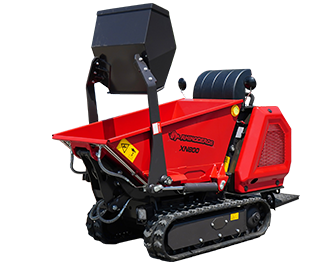
The current Rhinoceros mini dumper lineup, including the KS3000, XN500E, KS2700TE, and KS450E, are standard tipping models built around payload capacity, track or wheel stability, and power source choice rather than an integrated loading arm. If a self-loading configuration is specifically what a project needs, confirm current availability directly with Rhinoceros, since product lineups and configuration options change over time and this article isn't a substitute for a current spec sheet.
How to evaluate a self-loading model if you do need one
If the five questions above point toward genuinely needing self-loading capability, the evaluation shifts to a different set of specs than a standard dumper comparison. Loading arm reach and lift height determine what pile heights and distances the machine can actually work with. Arm cycle time affects how many loads per hour a single operator can realistically manage. And bucket or arm capacity per cycle should be evaluated separately from the dumper's total hauling payload, since the two numbers answer different questions: how much the arm picks up per scoop, versus how much the bed can carry per trip.
A machine with a fast, high-capacity loading arm paired with a smaller hauling bed can actually move less material per hour than a slower arm paired with a larger bed, depending on haul distance and cycle pattern, which is why total workflow throughput matters more than any single spec in isolation.
The market context, briefly
The broader self-loading and compact dumper segment has shown consistent growth over the past several years, tracking a wider market pattern in drum and mini dumpers reaching billions of dollars in global value with continued expansion projected through the end of the decade.
That sustained demand is also why buyers researching this category will find no shortage of self-loading options from a wide range of manufacturers, which makes the five-question framework above more useful than ever for narrowing an increasingly crowded field down to what a specific job actually requires.
Self-loading vs standard, side by side
| Factor | Standard dumper | Self-loading dumper |
|---|---|---|
| Operators typically needed | Two, one to load and one to haul | One |
| Purchase price | Lower for a given payload class | Higher for a given payload class |
| Maintenance points | Tipping mechanism and drivetrain only | Adds loading arm hydraulics |
| Best fit | Site already has a loader or excavator | Solo operator, no other loading equipment on site |
General category comparison based on published buyer guidance for the self-loading mini dumper segment, August 2026.
Job types where the arm earns its cost
Certain work patterns consistently favor a self-loading model over the alternative of a standard dumper plus separate equipment.
Scattered small residential jobs
A landscaper moving between several small residential sites in a week rarely justifies trailering a separate mini excavator to each stop just to fill a dumper bucket a few times. A self-loading model removes that logistics problem entirely.
Trench backfilling after utility work
Backfilling a trench with loose spoil piled beside it is close to ideal work for a self-loading arm: material is already broken up, sitting at grade, and doesn't need excavation-grade digging force to move.
Nursery, greenhouse, and material yard work
Repeatedly moving mulch, soil, or aggregate around a fixed yard or nursery layout is a repetitive, predictable task that a self-loading dumper handles well without needing a second machine on standby all day.
Job types where it usually isn't worth it
A demolition site with broken concrete, a foundation dig requiring real digging force, or any job where material needs to be excavated rather than simply scooped, still needs a proper excavator regardless of whether the dumper hauling it away can self-load. In those cases, the self-loading arm on the dumper duplicates a function the excavator already performs better, and the added cost buys little extra capability.
A large-volume job moving material in bulk over a full day also tends to favor a standard, higher-payload dumper paired with a dedicated loader, since a purpose-built loader generally cycles material faster than a dumper's integrated arm, which is sized for convenience rather than maximum throughput.
How this differs from just buying a mini excavator
It's worth being direct about a common point of confusion: a self-loading mini dumper's arm is not a substitute for a dedicated mini excavator's digging capability. The arm on a self-loading dumper is sized and positioned for loading loose material into the machine's own bed, not for trenching, breaking ground, or working at real digging depth. A crew that needs both hauling and genuine excavation still needs both types of machine, or a dumper plus a separate mini excavator, rather than assuming a self-loading arm covers both roles.
Rental and financing availability
Self-loading models are increasingly available through equipment rental channels specifically because of the crew-size savings they offer on short-term jobs, which makes renting one for a trial period a reasonable way to test whether the workflow fits before committing to a purchase. For a contractor still deciding between the two categories, a short rental period on an actual job site tends to answer the question faster than any spec comparison can.
A realistic workflow comparison
Picture a single operator backfilling a 30-meter trench with spoil piled along its length. With a standard dumper, that operator either hand-shovels material into the bucket repeatedly, or stops the job to bring in a second machine or a second person. With a self-loading model, the same operator scoops, hauls a short distance, dumps, and repeats, without switching tasks or waiting on anyone else.
That difference compounds over a full day of repetitive cycles in a way that's easy to underestimate from a spec sheet alone. It's also exactly the scenario the five-question framework above is designed to catch: solo operator, loose material, no other loading equipment already on site.
Reading past the marketing language in listings
Not every listing described as "self-loading" means the same thing. Some genuinely integrate a hydraulic arm into the machine. Others use the term more loosely to describe a low tipping angle or an easy-fill bucket shape that still requires a separate loading source. Before comparing prices across listings, confirm specifically whether the machine has its own powered loading arm, or whether "easy loading" is describing something else entirely.
This distinction matters most when comparing across suppliers rather than within a single manufacturer's lineup, since terminology consistency tends to be higher within one brand's published specifications than it is across a broad marketplace search.
What to ask a supplier before ordering a self-loading model
Beyond the five decision questions above, a few supplier-specific questions help avoid a mismatch between expectation and delivery. Ask for the loading arm's maximum reach and lift height in writing, not just a general description. Ask whether the arm's hydraulic function shares a pump with the tipping mechanism, since shared hydraulics can mean reduced simultaneous performance under heavy use. And ask directly whether the quoted payload figure accounts for the arm's own weight, or reflects the chassis rating before the arm was added, since suppliers don't always specify which figure they're quoting.
Why crew structure matters more than job size alone
It's tempting to size this decision purely around job scale, bigger jobs need bigger machines, but crew structure is often the better predictor. A two-person crew working a large site with a dedicated loader operator has less need for self-loading capability than a solo operator working a series of small sites, even if the solo operator's individual jobs are smaller. The feature solves a staffing problem as much as a capacity problem, which is why it's worth evaluating against how a business actually staffs its jobs, not just against square footage or material volume.
This is also why self-loading adoption has grown fastest among small, owner-operator contractors rather than larger fleets with dedicated equipment operators for each machine type. The larger the crew, the more likely a loader operator already exists somewhere in the workflow, which reduces the marginal value of building loading capability into the dumper itself.
A simple way to decide
If a crew regularly works alone on small, scattered sites without another loader available, the self-loading premium tends to pay for itself in saved labor and reduced crew size relatively quickly. If a loader or excavator is already part of the regular equipment mix, a standard dumper paired with that existing equipment is usually the more cost-effective choice, since paying for a built-in loading arm that duplicates equipment already on hand adds cost without adding real workflow value.
Frequently asked questions
Is a self-loading mini dumper more expensive to maintain long-term?
Generally yes, since the loading arm adds hydraulic components that need their own inspection and service on top of the standard dumper maintenance routine.
Can a self-loading dumper handle the same terrain as a standard one?
Generally yes for the undercarriage itself, but the added weight and height of the loading arm can shift the machine's balance point, so terrain and slope limits are worth confirming against the specific model's rated specifications.
Does self-loading capability replace the need for a separate excavator entirely?
Only for lighter, loose material within the arm's reach and lift capacity. It's not a substitute for a full excavator on jobs involving hard digging, deep trenching, or material that needs to be broken up before loading.
Is a self-loading model worth it for occasional, not daily, use?
Less often. The cost premium is easiest to justify with frequent use, since the labor savings need enough working days to offset the higher purchase price.
Does Rhinoceros currently offer a self-loading mini dumper?
The current standard lineup is built around tipping-only models. Confirm directly with Rhinoceros for the most current configuration options available for your market.
What's the biggest mistake buyers make when choosing between self-loading and standard models?
Assuming the feature is worth the premium without first checking whether a loader or extra crew member is already available on most job sites, which is the single factor that most often makes the added cost unnecessary.
Specifications and configuration availability vary by manufacturer and model; confirm current specifications directly with Rhinoceros before purchase.