 中文
 Español
 Francés
 Русский
 Português
 العربية
 Deutsch
 Italiano
 한국인
 Melayu
 ไทย
 Việt
 bahasa Indonesia
 қазақ
 Nederlands
 Ελληνικά
 Magyar
 čeština
 Suomalainen
 Filipino
Piston pump on the XN13: what it changes when you combine functions
Piston pump on the XN13: what it changes when you combine functions
Our spec sheet lists "Piston Pump" as a feature. Here is what variable displacement actually does the moment you run boom, arm, and swing together, compared with a fixed-displacement gear pump.
The real spec this article explains
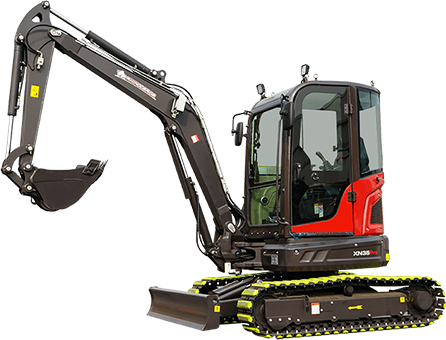
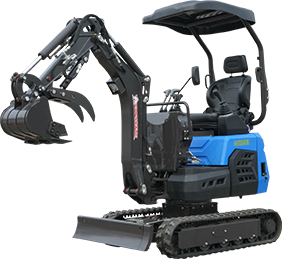
Our XN13 mini excavator page lists a piston pump among its features, alongside the pilot control system and top-mounted boom cylinder covered in our other XN13 engineering notes. Piston pump is a specific, well-documented hydraulic pump category, not a vague power claim. The property that actually matters for day-to-day digging is one word most buyers skip past: displacement.
Fixed displacement versus variable displacement
A hydraulic pump's "displacement" is how much fluid it moves per rotation. This is the real dividing line between pump types, more than the name itself.
Gear pumps: fixed displacement
A gear pump creates pressure by meshing gear teeth, forcing a fixed volume of fluid around the gears on every rotation. Industry documentation on hydraulic pump types is consistent: gear pumps have fixed displacement, meaning the flow they produce does not adjust to what a given function actually needs at that moment. They are simpler, more affordable, and, according to engineering comparisons, carry a mean time between failures exceeding 15,000 hours in standard use, a genuinely reliable, rugged design.
Piston pumps: variable displacement
An axial piston pump uses a set of pistons arranged parallel to the drive shaft, and critically, the stroke of those pistons can be adjusted. Industry sources describe this variable displacement capability as the specific reason piston pumps are the standard main pump choice on modern excavators: the pump can change how much fluid it delivers in response to the combined demand of the functions actually running, rather than always outputting the same volume regardless of what is happening.
What this changes the moment you combine functions
Running one function alone, lifting the boom with nothing else engaged, rarely exposes the difference between pump types in a way you would notice. The difference shows up specifically when you ask the hydraulic system to do several things at once, which is most of actual digging: curling the bucket while swinging, or raising the boom while repositioning the arm.
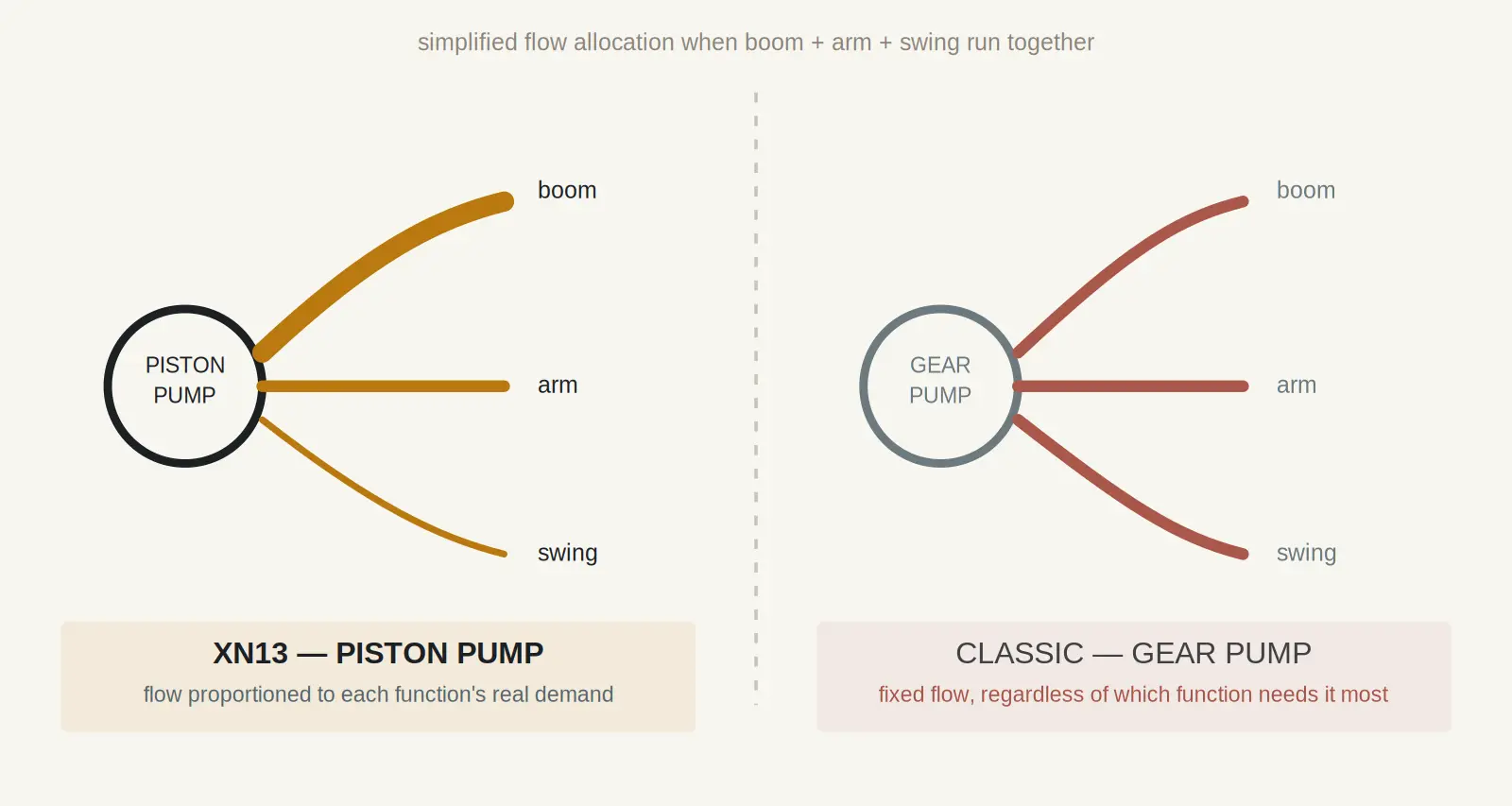
With a fixed-displacement gear pump, the total flow available does not change based on what is happening across functions. If two functions are both calling for flow at once, each receives a share of a fixed total, which can mean one function moves more sluggishly than it would on its own, or the combined movement feels less proportional to how you are actually moving the joysticks. With a piston pump's variable displacement, the pump can adjust its total output toward what the combined demand actually calls for, which is part of why engineering sources tie piston pumps to the kind of fine, responsive multi-function control expected on a modern mini excavator.
The efficiency difference behind this
This is not only a control-feel question; it has a measurable energy cost. Engineering comparisons report premium axial piston units reaching 88% to 93% total efficiency, with the efficiency gap against gear pumps widening specifically under partial-load conditions, because a variable-displacement pump can adjust its stroke to match the load while a fixed-displacement gear pump keeps moving the same volume whether it is needed or not. Industry analysis attributes meaningful fuel savings, in the range of 12 to 15%, to excavators built around variable-displacement piston pumps compared with fixed-displacement designs doing comparable work.
Side by side
| Piston pump (XN13) | Gear pump (classic) | |
|---|---|---|
| Displacement | Variable, adjusts to demand | Fixed |
| Behaviour running one function alone | Comparable | Comparable |
| Behaviour combining multiple functions | Flow proportioned to real demand | Fixed total shared regardless of demand |
| Typical total efficiency | 88–93% | Lower, especially under partial load |
| Mechanical robustness / MTBF | Good | Very high, simple design |
| Typical cost | Higher | Lower, roughly 30% less to manufacture |
Where this connects to load-sensitive hydraulics generally
If this sounds related to the concept of a "load sensitive hydraulic system," it is: a variable-displacement piston pump is the component that makes genuine load-sensing control possible in the first place. A fixed-displacement gear pump cannot participate in that kind of system the same way, since it has no adjustable output to command. This is the same underlying principle behind load-sensitive hydraulics on our wheel excavator range, applied here specifically to how the XN13 handles combined, simultaneous digging functions.
What this does not mean
A piston pump does not make every single-function movement dramatically different from a gear pump, and a gear pump is not an unreliable or outdated choice, its simplicity and very high mean time between failures are genuine advantages, particularly on lighter-duty or more cost-sensitive machines. The real, specific advantage of a piston pump shows up in combined, multi-function digging and in efficiency under partial load, not as a blanket claim that it makes everything "better."
What to ask before you compare two mini excavators
Is the main pump a piston pump or a gear pump on this specific model?
If piston, is it variable displacement, and what control strategy does it use, load-sensing, constant pressure, or another?
How does the machine behave running two or three functions together, not just one function in isolation, when you test it?
What fuel consumption figures, if any, are available comparing similar machines with each pump type?
Send us your typical digging work, how often you combine boom, arm, and swing in a single motion, through our inquiry form, and we can confirm the XN13's pump specification for your use case. You can review the full specification on the XN13 product page.
Frequently asked questions
What does "piston pump" mean on the XN13?
It means the main hydraulic pump uses pistons with adjustable stroke, known as variable displacement, rather than a fixed-volume gear mechanism.
Does a piston pump make the XN13 more powerful overall?
Not simply more powerful in a general sense. Its real advantage is proportioning hydraulic flow to combined, simultaneous functions and improving efficiency, particularly under partial load.
When would I actually notice the difference between a piston pump and a gear pump?
Most noticeably when combining two or more functions at once, such as swinging while curling the bucket, rather than running a single function in isolation.
Is a gear pump a bad choice?
No. Gear pumps are simple, affordable, and very reliable, with reported mean time between failures exceeding 15,000 hours. They are a reasonable choice for lighter-duty or more cost-sensitive machines.
Does a piston pump actually save fuel?
Industry analysis associates variable-displacement piston pumps with meaningful fuel savings, commonly cited in the range of 12 to 15%, compared with fixed-displacement designs doing comparable work.
Is this the same thing as a "load sensitive hydraulic system"?
Related, not identical. A variable-displacement piston pump is the component that makes true load-sensing control possible. A fixed-displacement gear pump cannot support that kind of system the same way.
Feature availability varies by model and configuration; confirm current specifications directly with Rhinoceros before purchase. Comparisons of pump types describe general hydraulic engineering principles reported across the industry and are not claims made about specific competitor products by Rhinoceros.