 中文
 Español
 Francés
 Русский
 Português
 العربية
 Deutsch
 Italiano
 한국인
 Melayu
 ไทย
 Việt
 bahasa Indonesia
 қазақ
 Nederlands
 Ελληνικά
 Magyar
 čeština
 Suomalainen
 Filipino
Pilot control on the XN13: what it actually changes
Pilot control on the XN13: what it actually changes
Our spec sheet lists "Pilot control" as a feature. Here is what moves differently inside the hydraulic circuit compared with a mechanical lever, and what each one trades away.
The real spec this article explains
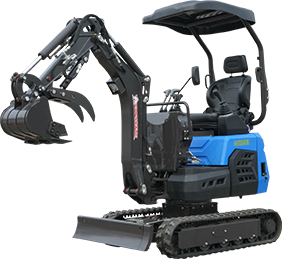
Our XN13 mini excavator page lists pilot control among its features, alongside a swing boom, telescopic chassis, and the top-mounted boom cylinder covered in our companion article. "Pilot control" is a specific, well-documented control architecture, not a vague comfort claim, and understanding exactly what it changes helps you judge whether it matters for how you plan to use the machine.
Two different ways to move a valve spool
Every excavator function, boom, arm, bucket, swing, is ultimately controlled by a main hydraulic valve spool shifting position to send high-pressure fluid where it is needed. The question is what actually moves that spool when you push the joystick or lever.
Mechanical control: you move the spool directly
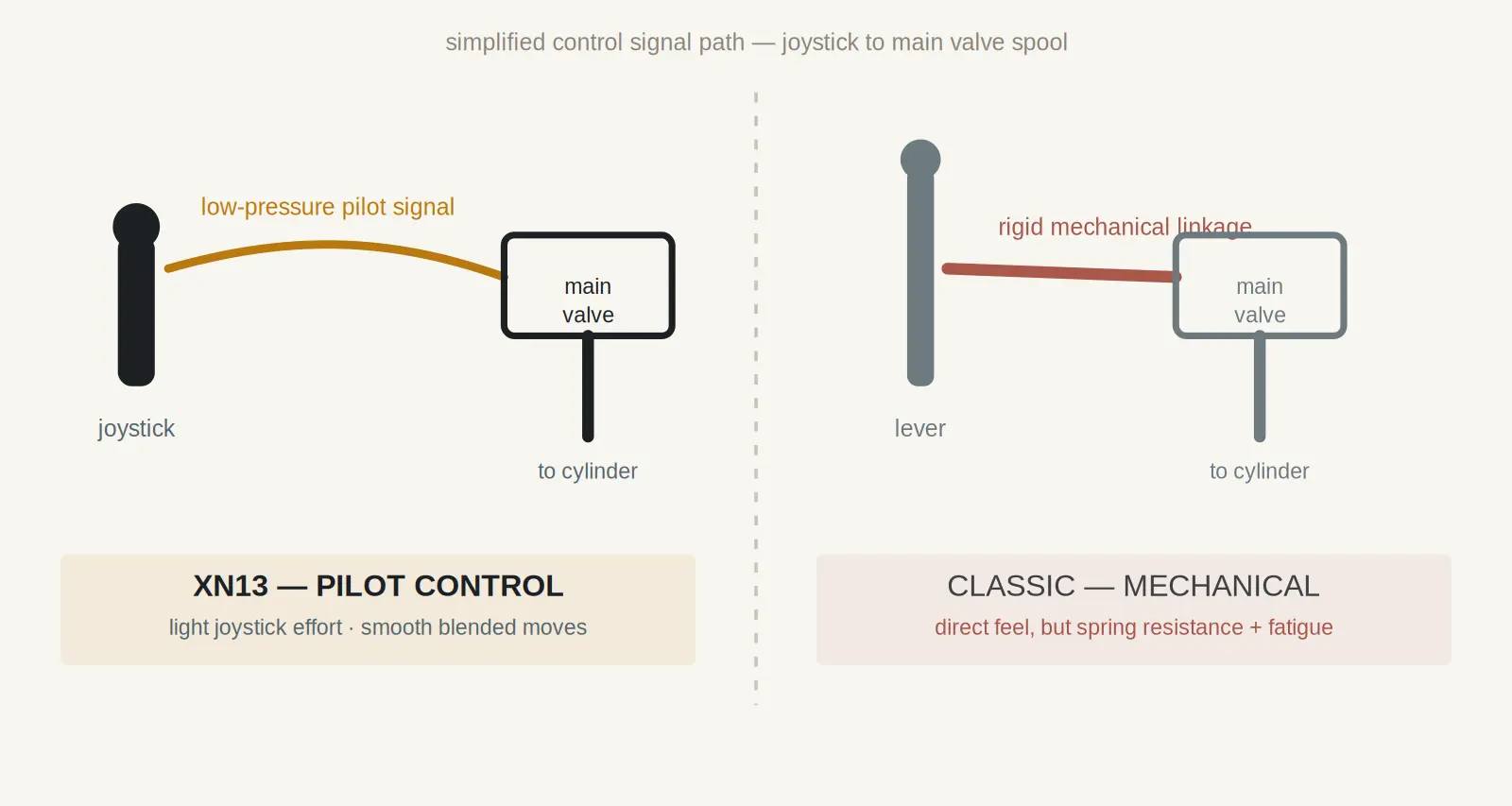
On a mechanical control machine, the lever is physically connected to the main valve spool through a linkage. Industry explanations of this system are consistent: when you push the lever, you are directly shifting the spool, working against the resistance of return springs inside the valve itself. There is no intermediate hydraulic stage.
Pilot control: the joystick sends a signal, not a push
On a pilot control machine, the joystick does not touch the main spool at all. Industry documentation on mini excavator pilot systems describes it plainly: moving the joystick modulates a low-pressure pilot signal, and that pilot pressure is what shifts the main valve spool. One industry explanation compares it directly to power steering in a car: a small, light input commands a much larger hydraulic force to do the actual work.
What changes in practice
1. Effort and fatigue
This is the most consistently reported difference across operator and industry sources. Mechanical levers require you to physically overcome valve spring resistance on every movement, all day. Pilot joysticks require only enough force to modulate a low-pressure signal. Industry sources describing this trade-off note mechanical controls often lead to higher reported wrist and arm fatigue, particularly over a full shift.
2. Combined, blended movements
Real digging rarely uses one function at a time. Curling the bucket while swinging, or raising the boom while curling, is normal work. Industry comparisons describe mechanical linkages as prone to feeling "clunky" when two levers are moved together, since the physical linkages are, in effect, competing for position. A pilot system's hydraulic signal paths do not have that same physical interference, which sources describe as allowing smoother, more blended simultaneous movement.
3. Tactile feedback: the one place mechanical wins
This is the genuine trade-off, not a point against pilot control in general. On a mechanical lever, when the bucket strikes a buried rock or hard object mid-dig, industry documentation explains that the operator feels that resistance directly through the linkage, as increased pressure on the lever itself, giving an immediate physical warning before damage occurs. A pilot system's light, consistent joystick feel does not transmit that same raw mechanical resistance in the same way, since the operator's hand is modulating a signal, not fighting the load directly.
4. Cost and complexity
Mechanical systems are simpler: no pilot pump, no low-pressure pilot lines, no pilot filter to maintain. Industry sources put mechanical control systems at roughly $2,000 to $5,000 less than a comparable pilot-control machine, and note they avoid any risk of pilot-line leaks inside the cab. Pilot systems add components, and depend on clean hydraulic fluid in the pilot circuit to keep that light, consistent feel working correctly over time.
Side by side
| Pilot control (XN13) | Mechanical lever (classic) | |
|---|---|---|
| Joystick / lever effort | Light | Higher, works against spring resistance |
| Combined / blended movement feel | Smooth | Can feel clunky under combined input |
| Direct tactile feedback (hitting a hard object) | Reduced | Direct, immediate |
| Upfront cost | Higher | Typically $2,000–$5,000 less |
| System complexity / maintenance | Pilot pump, lines, filter to maintain | Fewer components |
| Operator fatigue over a full shift | Generally lower | Generally higher |
What this does not mean
Pilot control is not simply "the premium option" and mechanical is not simply "the budget option" in every sense that matters to you. If you value feeling exactly when the bucket contacts something solid underground, direct mechanical feedback is a real, specific advantage, not a limitation of an older system. If you run the machine for full shifts and value smoother combined movements, pilot control's reduced effort is a real, specific advantage too. Neither is a universal upgrade over the other; they are two different ways of connecting your hand to the hydraulic circuit, suited to different priorities.
What to ask before you compare two mini excavators
Is the control system pilot or mechanical on this specific model, and is that an option or fixed?
If pilot, what maintenance does the pilot circuit itself require, filter changes, fluid cleanliness standards?
If you dig in rocky or debris-heavy ground often, have you tested how each system communicates hitting a hard object?
What is the actual price difference between the two control types for the model you are comparing?
Send us your typical ground conditions and how many hours a day the machine runs through our inquiry form, and we can help you think through which control type fits your work. You can review the full specification on the XN13 product page.
Frequently asked questions
What does "pilot control" mean on the XN13?
It means the joystick does not move the main hydraulic valve directly. Instead, it modulates a low-pressure pilot signal that shifts the main valve spool, similar in principle to power steering.
Is pilot control easier to use than a mechanical lever?
It generally requires less physical effort and is reported to cause less fatigue over a full shift, since the operator is not working directly against the main valve's spring resistance.
Does pilot control lose the tactile feel of hitting a hard object underground?
It reduces that direct mechanical feedback compared with a lever physically linked to the valve. Mechanical control is the one specific area where a direct linkage has a genuine advantage.
Is mechanical control cheaper?
Generally yes. Industry sources put mechanical-control machines at roughly $2,000 to $5,000 less than a comparable pilot-control model, reflecting the simpler system with fewer components.
Does pilot control need special maintenance?
Yes. The pilot circuit depends on clean hydraulic fluid and a functioning pilot filter to keep its light, consistent control feel working correctly over time.
Which control type is better for combined movements, like swinging while curling the bucket?
Pilot control is generally smoother for blended, simultaneous movements, since its hydraulic signal paths do not have the physical linkage interference a mechanical system can have.
Feature availability varies by model and configuration; confirm current specifications directly with Rhinoceros before purchase. Comparisons of control system behaviour describe general mini excavator engineering principles reported across the industry and are not claims made about specific competitor products by Rhinoceros.