 中文
 Español
 Francés
 Русский
 Português
 العربية
 Deutsch
 Italiano
 한국인
 Melayu
 ไทย
 Việt
 bahasa Indonesia
 қазақ
 Nederlands
 Ελληνικά
 Magyar
 čeština
 Suomalainen
 Filipino
Mini Dumper vs Wheelbarrow: When Does It Pay Off?
Reviewed by Justin, Product Engineer·Based on official factory specifications and industry reporting, August 2026
TL;DR: A wheelbarrow costs less upfront. A mini dumper costs less per load once distance, trip count, and labor hours are counted. The crossover point depends on how far material actually travels.
A wheelbarrow costs a few hundred dollars. A mini dumper costs many times that. On sticker price alone, the wheelbarrow wins every time. The problem is that sticker price isn't what a wheelbarrow actually costs a job.
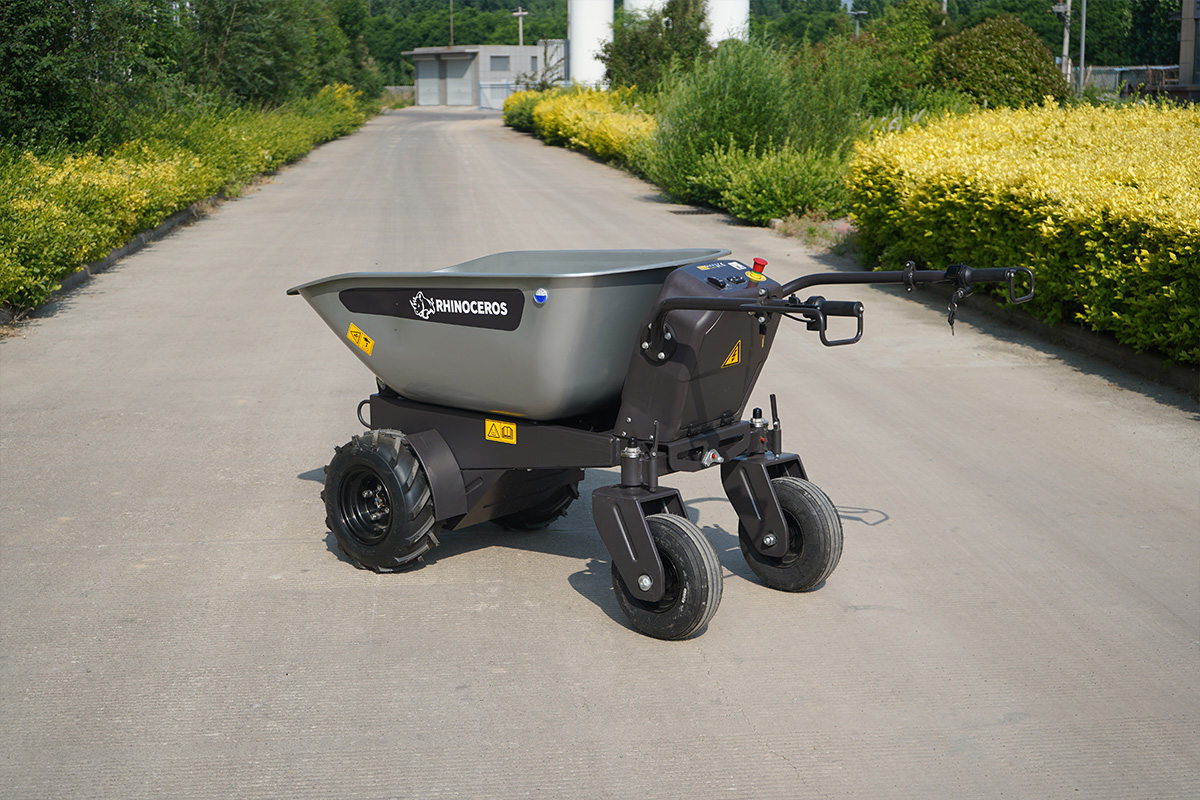
The cost nobody puts on the wheelbarrow's price tag
A wheelbarrow's real cost shows up in paid labor time, not in the purchase price. Every loaded trip from a material pile to a drop point creates a matching empty return trip, and every minute spent walking instead of placing, spreading, or finishing material is paid time that produces nothing. Industry cost analysis of manual material handling identifies distance, not the wheelbarrow itself, as the actual driver of that hidden cost, since a short haul barely registers while a long one compounds fast across a full day, according to wheelbarrow productivity cost analysis.
That framing matters more than most buyers expect walking into this decision. The question isn't "wheelbarrow or dumper" in the abstract. It's "how far is the material actually traveling, and how many trips does that take."
Five numbers that actually decide this
Haul distance in meters between the material pile and the drop point
Trips per day needed to move the full volume of material
Load capacity per trip, wheelbarrow versus mini dumper
Operator hourly labor rate, since that's what every extra minute of walking actually costs
Ground condition, since soft or uneven ground slows a wheelbarrow far more than it slows a tracked dumper
A job with a short haul distance and low trip count rarely justifies the upgrade. A job with long hauls, high trip counts, or difficult ground almost always does, and the gap between those two scenarios is usually obvious within the first hour of work, not something that needs a spreadsheet to identify.
Where the wheelbarrow still wins
Short, occasional jobs with easy, flat access rarely benefit from a mini dumper's added cost and complexity. A small residential flower bed a few meters from the driveway, a one-time cleanup with a handful of loads, or any job where the total material moved wouldn't fill a mini dumper's bed more than once or twice, the wheelbarrow remains the practical choice. Bringing a powered machine to a job that size adds transport logistics and cost without adding meaningful time savings.
Where the math flips fast
Distance is the single biggest multiplier. A 50-meter haul repeated dozens of times a day turns a wheelbarrow's per-trip time cost into a major share of total labor hours on that job. A mini dumper covering the same distance faster, carrying more per trip, and not slowing down as the operator tires late in the day closes that gap quickly.
Ground condition compounds the effect. A wheelbarrow on soft, muddy, or uneven ground slows dramatically, sometimes to the point of becoming unusable without a plank path or repeated digging-out. A tracked mini dumper's larger footprint and power keep moving through exactly the conditions that stall a wheelbarrow, which is often where the real time savings concentrate rather than in the raw speed difference on flat, dry ground.
A simple way to estimate your own crossover point
Multiply expected daily trips by round-trip walking time to get total daily labor minutes spent on hauling alone. Multiply that by the operator's hourly rate to get a daily labor cost for manual hauling. Compare that daily figure against what a mini dumper would save per day, faster trips, larger loads meaning fewer total trips, and no slowdown on rough ground, and a realistic payback timeline for the machine emerges without needing a formal financial model.
A job running that calculation for a single day rarely justifies a purchase. A job repeating that calculation across weeks or months of similar work usually does, which is why this decision tends to matter most for contractors and landscaping crews with recurring material-moving work rather than occasional DIY projects.
Real-world examples where the switch paid off
Cost analysis of contractor material handling has documented meaningful returns from switching from wheelbarrow-based transport to a mini dumper, with one landscaping contractor case showing over 200% first-year return once labor savings, time savings, and reduced ground damage were all accounted for against the machine's purchase and operating costs. Separate industry coverage of timber and yard operations found that switching from wheelbarrow-based internal transport to a self-loading mini track dumper cut cycle time by 40 to 70 percent compared with manual cart transport, particularly where the workflow already involved repetitive load-transport-tip cycles.
Those figures are specific to the operations studied, not a guarantee for every job, but the pattern is consistent: the more repetitive and distance-heavy the hauling task, the larger the documented return tends to be.
What a mini dumper does that a wheelbarrow structurally can't
Beyond speed, a powered dumper changes what's physically possible on a job, not just how fast it happens. A wheelbarrow's capacity is limited by what one person can safely push, typically well under what a mini dumper's bed can hold in a single load. That capacity gap means fewer total trips for the same volume of material, which compounds the time savings beyond just per-trip speed.
A mini dumper also removes a physical strain factor a wheelbarrow can't avoid. Repeated pushing and lifting across a full workday is a real source of fatigue and injury risk on manual hauling jobs, and reducing that repetitive strain has value beyond the raw time saved, both for the worker and for the consistency of pace across a long shift.
The middle ground: motorized wheelbarrows
Between a manual wheelbarrow and a full mini dumper sits a smaller category worth knowing about: motorized or powered wheelbarrows, essentially a wheelbarrow form factor with a small engine or electric motor doing the pushing. These occupy a genuine middle ground on cost and capability, useful for a crew that needs more than manual power but doesn't need a mini dumper's full payload capacity or track stability. They're not a direct substitute for either end of this comparison, but worth considering for jobs that fall between the two use cases described above.
Transport and logistics: the part buyers forget to compare
A wheelbarrow needs no special transport, it fits in the back of almost any vehicle. A mini dumper needs a trailer or truck bed rated for its weight, which adds a logistics cost that doesn't show up in the machine's purchase price alone. For a contractor already trailering other equipment to job sites, this is a minor addition. For a smaller operation without existing trailer capacity, it's a real cost worth factoring into the total decision, not just the machine price itself.
Fuel and power source: another variable in the comparison
A wheelbarrow costs nothing to fuel. A mini dumper's running cost depends heavily on power source, and that gap has widened as fuel prices have climbed. Electric mini dumpers now offer a meaningfully lower cost per hour of operation than diesel or gasoline equivalents, with some industry estimates putting electric power at roughly 70 percent cheaper per operating hour than combustion engines once maintenance differences are included, according to industry reporting on electric-powered material handling equipment. That gap matters more the more hours a machine actually runs, which loops back to the same core variable driving this entire decision: how much the machine is actually used.
A closer look at what "labor cost" actually includes
It's worth breaking down what gets counted as labor cost in this comparison, since it's easy to undercount. It's not just the walking time itself. It includes the loading time at the pile, the dumping time at the destination, and the fatigue-driven slowdown that happens later in a shift as repeated manual trips wear on an operator. A mini dumper doesn't just move faster per trip, it also tends to maintain a more consistent pace across a full day, since the physical effort per cycle is dramatically lower than pushing a loaded wheelbarrow.
That consistency is easy to overlook in a simple per-trip time comparison, but it matters on any job long enough for fatigue to become a factor, which is most full working days involving repetitive material transport.
How crew size interacts with this decision
A solo operator moving material alone feels the wheelbarrow's labor cost most directly, since every minute spent hauling is a minute not spent on any other task. A larger crew with a dedicated laborer for material transport spreads that cost differently, since hauling doesn't necessarily block other work from happening in parallel. This is part of why the same job can have a different real answer depending on crew structure, not just job size or distance alone, similar to how equipment decisions play out across other compact machine categories.
What Rhinoceros models fit which side of this comparison
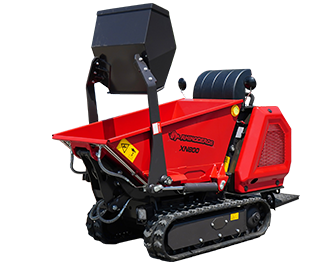
For buyers already convinced the upgrade makes sense, machine choice still matters. The XN500E's light weight and compact footprint suit jobs where a wheelbarrow was being used partly for its ability to fit through tight gates and doorways, since the machine trades some payload for that same accessibility. The KS3000 and KS2700TE suit higher-volume, more frequent hauling where raw payload and consistent daily use matter more than tight-access maneuverability. Matching the specific model to the job's access constraints and volume, not just choosing "a mini dumper" generically, determines how much of the labor-saving potential actually gets realized.
Common hesitations, and whether they hold up
"A wheelbarrow is simpler, nothing to break"
True in the narrowest sense, but a wheelbarrow's simplicity doesn't eliminate labor cost, it just hides it in payroll rather than a maintenance invoice. A mini dumper's maintenance needs are real, but modest relative to the labor hours it can save on the right job.
"We only need it occasionally, not worth owning"
This is often correct, and it's exactly the scenario renting a mini dumper for specific larger jobs solves, capturing the labor savings without the ownership commitment or idle-time cost of a machine sitting unused most of the year.
"Our crew is small, we don't have someone dedicated to hauling"
This is actually a stronger argument for switching, not against it. A solo or small crew feels manual hauling's time cost most directly, since there's no one else to absorb that labor while hauling happens.
A simple decision framework
If most jobs involve short hauls, small volumes, or easy flat access, a wheelbarrow remains the more cost-effective tool, and a mini dumper purchase would mostly sit idle relative to its cost. If jobs regularly involve longer hauls, higher volumes, or difficult ground, the labor time saved by a mini dumper typically justifies the added cost within a reasonable number of working days, and the earlier the switch happens, the sooner that saved labor time starts compounding into real cost savings rather than continuing to pay for hauling that a machine could do faster.
A note on resale and long-term value
A wheelbarrow has essentially no resale value and a short working life under heavy use. A mini dumper, maintained reasonably, retains real resale value for years, which offsets some of the higher upfront cost when comparing total cost of ownership rather than just the purchase price. A buyer weighing the decision purely on sticker price is comparing an expendable tool against a capital asset, which understates the mini dumper's economics over any multi-year time horizon.
Putting the whole comparison in one place
Short hauls, small volumes, tight access, and occasional use favor the wheelbarrow. Long hauls, high trip counts, difficult ground, and regular recurring work favor the mini dumper, often by a wide enough margin that the upgrade pays for itself within weeks rather than years once the job genuinely fits that profile. The honest answer for most contractors and landscaping crews isn't choosing one tool permanently, it's recognizing which jobs call for which tool and having both available rather than forcing every job through the same equipment.
Frequently asked questions
Is an electric mini dumper a fair comparison against a wheelbarrow for indoor work?
Often yes, since electric models produce no exhaust and tend to be quieter, making them more practical than a diesel machine for indoor or noise-sensitive environments where a wheelbarrow would otherwise be the default choice.
How much material volume justifies switching from a wheelbarrow?
There's no universal threshold, but jobs requiring more than a handful of wheelbarrow loads per day, especially over any real distance, tend to be where the time savings become significant enough to matter.
Does a mini dumper require special training a wheelbarrow doesn't?
Yes, operating powered equipment safely requires more training than pushing a wheelbarrow, which is a real added cost and time investment worth factoring into the decision, particularly for a first-time buyer.
Can a mini dumper go everywhere a wheelbarrow can?
Not always. A wheelbarrow's smaller footprint can fit through some tight gates or indoor spaces a mini dumper can't, so site access should be checked before assuming the switch is straightforward.
Is renting a mini dumper for a single large job a reasonable middle ground?
Yes, renting is a practical way to capture the labor savings on a specific large job without committing to full ownership, particularly for a contractor still deciding whether recurring work justifies a purchase.
Does ground damage factor into the wheelbarrow versus mini dumper decision?
It can. A tracked mini dumper generally causes less ground disturbance than repeated wheelbarrow trips across the same soft path, which matters on finished lawns or landscaped areas where surface damage has its own cost.
Cost and return figures cited reflect third-party industry analysis of specific documented cases, not a guarantee of results for any particular job. Specifications reflect standard Rhinoceros configurations and may vary by option package.