 中文
 Español
 Francés
 Русский
 Português
 العربية
 Deutsch
 Italiano
 한국인
 Melayu
 ไทย
 Việt
 bahasa Indonesia
 қазақ
 Nederlands
 Ελληνικά
 Magyar
 čeština
 Suomalainen
 Filipino
Mini Dumper Loads: Why "Half Full" Can Mean Overloaded
Reviewed by Justin, Product Engineer ·Based on official factory specifications and industry reporting, August 2026
TL;DR: Broken concrete weighs about 2,700 lbs per cubic yard. Wood framing weighs about 250. The same half-full bucket can be nowhere near its limit, or already over it.
A bucket that's visually half full tells you almost nothing about how close it is to the machine's rated payload. That number depends entirely on what's actually in it, and the gap between materials is bigger than most operators expect.
The density numbers that actually matter on a job site
| Material | Approx. weight per cubic yard |
|---|---|
| Broken concrete (demolition rubble) | ~2,700 lbs |
| Solid poured concrete | ~4,050 lbs |
| Roofing debris | ~700 lbs |
| Drywall | ~450 lbs |
| Wood framing | ~250 lbs |
Figures reflect published construction and demolition industry density references, according to construction debris weight calculation guidance and demolition waste density references, August 2026; actual weight varies by moisture content and material condition.
That's better than a 10-to-1 spread between the lightest and heaviest common material on this list. A bucket that handles a full load of wood framing without coming close to rated capacity can hit that same limit with broken concrete at a fraction of the volume.
Why "half full" is the wrong way to judge a load
Visual fullness measures volume, not weight, and a mini dumper's rated payload is a weight limit, not a volume limit. This is why an operator can look at a bucket that's clearly not full and still be at or near the machine's rated capacity, particularly with concrete, brick, or any dense masonry debris. The reverse is just as common: a bucket piled high with wood scraps or drywall can be nowhere near the weight limit despite looking overloaded.
The swell factor problem: broken material takes up more room than it did intact
Demolished concrete doesn't pack the same way solid concrete does. Broken chunks create air gaps that increase the material's effective volume even though the actual weight of material hasn't changed, a phenomenon industry references call the swell factor. That's part of why broken concrete's density per cubic yard runs lower than solid poured concrete's, roughly 2,700 lbs versus 4,050 lbs, even though it's the same underlying material.
Practically, this means a bucket of freshly broken concrete looks bulkier and less dense than the numbers on a spec sheet might suggest, which can lead an operator to underestimate how much weight is actually in the load if they're judging by how "solid" the pile looks.
Five questions worth asking before loading a mixed debris job
What's the dominant material in this load, not just what's visible on top?
Is the material wet, which adds meaningful weight beyond dry-condition reference figures?
Does the job mix light material, like framing, with dense material, like concrete or brick, in the same load?
How close is the bucket's visual fill level to what would be a full load of the heaviest material present?
Does the machine's rated payload have margin for a fully mixed, worst-case load, or only for the lightest material in the mix?
Why this matters more for demolition and renovation work specifically
New-build construction debris tends to be more predictable, mostly offcuts, packaging, and light material. Demolition and renovation work is where density surprises actually happen, since a single load can mix drywall, wood framing, and a chunk of concrete foundation in ways new-construction waste rarely does. That unpredictability is exactly why a density reference matters more on teardown and remodel jobs than on new-build sites.
Moisture: the variable that changes everything mid-project
Every figure in the table above assumes dry, typical material condition. Wet soil, rain-soaked debris, or material pulled from a site with standing water can weigh meaningfully more than dry reference values suggest, sometimes by a significant margin depending on how saturated it is. A load that would be well within limits dry can be pushing capacity after a rainy week, which is worth factoring in in wet climates or during rainy seasons specifically.
Where these reference numbers actually come from
The density figures used throughout this article aren't Rhinoceros-specific measurements, they're standard construction and demolition industry references used broadly across the waste and equipment sectors for exactly this kind of load-weight estimation. Solid poured concrete is consistently referenced around 4,050 pounds per cubic yard, or about 150 pounds per cubic foot, according to concrete weight calculation guidance, while broken, demolished concrete runs meaningfully lower per cubic yard due to the air gaps created during breaking. These are the same reference figures dumpster and waste-hauling companies use to size containers, which makes them a reasonable, independently sourced starting point for estimating mini dumper loads as well.
How this compares across a typical demolition project
A full single-family home teardown illustrates the density spread well: a 2,000 square foot home might generate roughly 240 cubic yards of mixed general debris, wood, drywall, roofing, alongside a much smaller 20 to 25 cubic yard allocation specifically for concrete from the foundation, according to demolition debris estimation guidance. Despite being a small fraction of the total volume, that concrete portion can represent a disproportionate share of the total project weight, which is exactly the pattern this article's density table is meant to help operators anticipate rather than discover mid-load.
A note on hauling multiple material types on the same job
Beyond weight, many jurisdictions and disposal facilities require concrete, wood, and other debris types to be separated rather than hauled mixed, both for recycling purposes and because mixed loads complicate accurate weight estimation at the disposal end. Keeping material types separated by load isn't just a weight-management practice, it also tends to align with disposal facility requirements a mini dumper operator will encounter at the drop-off point regardless of the loading strategy used on site.
A practical loading habit that avoids most overload problems
Rather than judging by visual fullness alone, identify the heaviest material actually going into a specific load first, then load conservatively toward that material's density rather than an average across the mix. For a load that's mostly wood framing with one chunk of concrete, treat the load's weight budget as though it were closer to all-concrete than the reference table's average would suggest, since a single dense component can dominate the total weight even in a visually mixed load.
What happens when a load exceeds rated payload
Beyond the immediate handling and stability concerns covered elsewhere, repeated overloading accelerates wear on the tipping mechanism, suspension, and drivetrain components in ways that aren't always visible until a failure happens. A single overloaded trip rarely causes immediate damage, but a pattern of consistently pushing past rated capacity compounds into real maintenance cost and shortened component life over the machine's working years.
Building a simple job-specific density estimate
For a recurring job type, it's worth building a rough personal reference rather than re-deriving density estimates from scratch each time. A landscaping crew hauling mostly soil and mulch faces a very different density profile than a demolition crew pulling old foundations, and after a handful of jobs, most operators develop a working sense of roughly how many bucket-loads of their typical material hits the machine's rated capacity. Cross-checking that working sense against the reference table above periodically, particularly when a job's material mix changes from the usual pattern, catches the moments where intuition built on one material type doesn't transfer cleanly to a different one.
Why this matters even more on electric models
The density and payload relationship covered throughout this article applies to every mini dumper regardless of power source, but it's worth flagging specifically for electric models, which tend to sit at the lighter end of the lineup's weight and payload range. A lighter machine has proportionally less margin for a density-estimation mistake than a heavier-duty diesel model with a larger rated payload buffer, which makes the "identify the densest material first" habit described above particularly worth building into routine practice on electric mini dumpers used for mixed renovation debris.
Confirm rated payload for your specific model
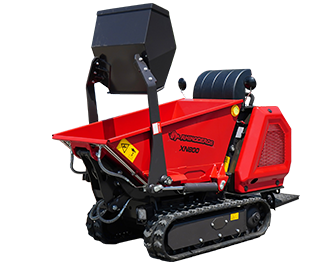
Rated payload varies by model across the Rhinoceros mini dumper lineup. Confirm the specific rated capacity for the model being used, and apply the density reference above to estimate whether a specific job's material mix fits within that rating before loading, rather than relying on visual judgment alone for dense or mixed debris.
Frequently asked questions
Is broken concrete always lighter than solid concrete by volume?
Generally yes, since the air gaps created by breaking increase the material's effective volume without adding weight, though the exact ratio varies by how finely the material was broken.
Does wet debris really weigh that much more than dry debris?
Yes, often meaningfully more, particularly for absorbent materials like wood or drywall, which is worth factoring into loading decisions during wet weather or on saturated sites.
What's the safest way to judge a mixed-material load?
Identify the densest material present and load conservatively toward that material's weight budget rather than averaging across the full mix.
Does overloading occasionally cause immediate damage?
Not usually from a single instance, but repeated overloading accelerates wear on the tipping mechanism and drivetrain over time, which shows up as reduced component life rather than sudden failure.
Should I weigh debris before loading if I'm unsure?
For genuinely uncertain mixed loads on jobs where overloading is a real risk, a rough density estimate using reference figures like those above is a practical middle ground between guessing and formally weighing every load.
Does this density reference apply the same way to a walk-behind and a larger ride-on mini dumper?
The material densities themselves don't change by machine type, but each model's specific rated payload does, so apply the same density logic against whichever model's actual rating applies.
Material density figures are general industry references and vary by moisture content, material condition, and regional material composition. Specifications reflect standard Rhinoceros configurations and may vary by option package; confirm current specifications directly with Rhinoceros.