 中文
中文
 Español
 Francés
 Русский
 Português
 العربية
 Deutsch
 Italiano
 한국인
한국인
 Melayu
 ไทย
ไทย
 Việt
Việt
 bahasa Indonesia
 қазақ
қазақ
 Nederlands
 Ελληνικά
 Magyar
 čeština
 Suomalainen
 Filipino
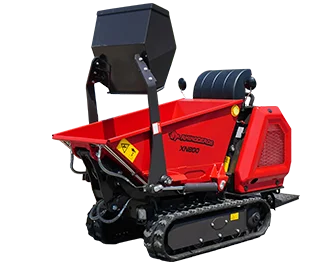
Mini Dumper Battery Life: Lithium vs Lead-Acid Cost
Reviewed by Justin, Product Engineer· Based on official factory specifications and industry reporting, August 2026
TL;DR: A lithium mini dumper battery typically lasts 8-12 years and 3,000+ cycles. Lead-acid lasts 4-6 years. Replacement is rare, not routine.
"What happens when the battery dies" is one of the first questions almost every buyer asks about an electric mini dumper, usually before asking about runtime or charging speed. It's a fair question. It's also one with a more reassuring answer than most buyers expect.
Lithium vs lead-acid: the numbers that actually matter
| Factor | Lithium (LiFePO4) | Lead-acid |
|---|---|---|
| Typical lifespan | 8–12 years | 4–6 years |
| Charge cycles | 3,000–5,000+ | ~500–1,500 |
| Usable capacity | 80–100% | ~50% |
| Maintenance | None required | Watering, voltage checks |
| Cost per kWh (2026) | $85–151 | Lower upfront, more replacements |
Figures reflect general 2026 small-scale lithium and lead-acid battery market data, not a specific Rhinoceros model quote.
The gap in usable capacity is easy to miss but matters in practice: a lead-acid battery rated for a given capacity typically only delivers about half of it safely, since deep discharge shortens lead-acid life dramatically. A lithium battery of the same rated capacity delivers close to its full rating, which is part of why a lithium-powered machine can run longer per charge than its raw capacity number alone might suggest against a lead-acid equivalent.
A real cost estimate, using an actual battery size
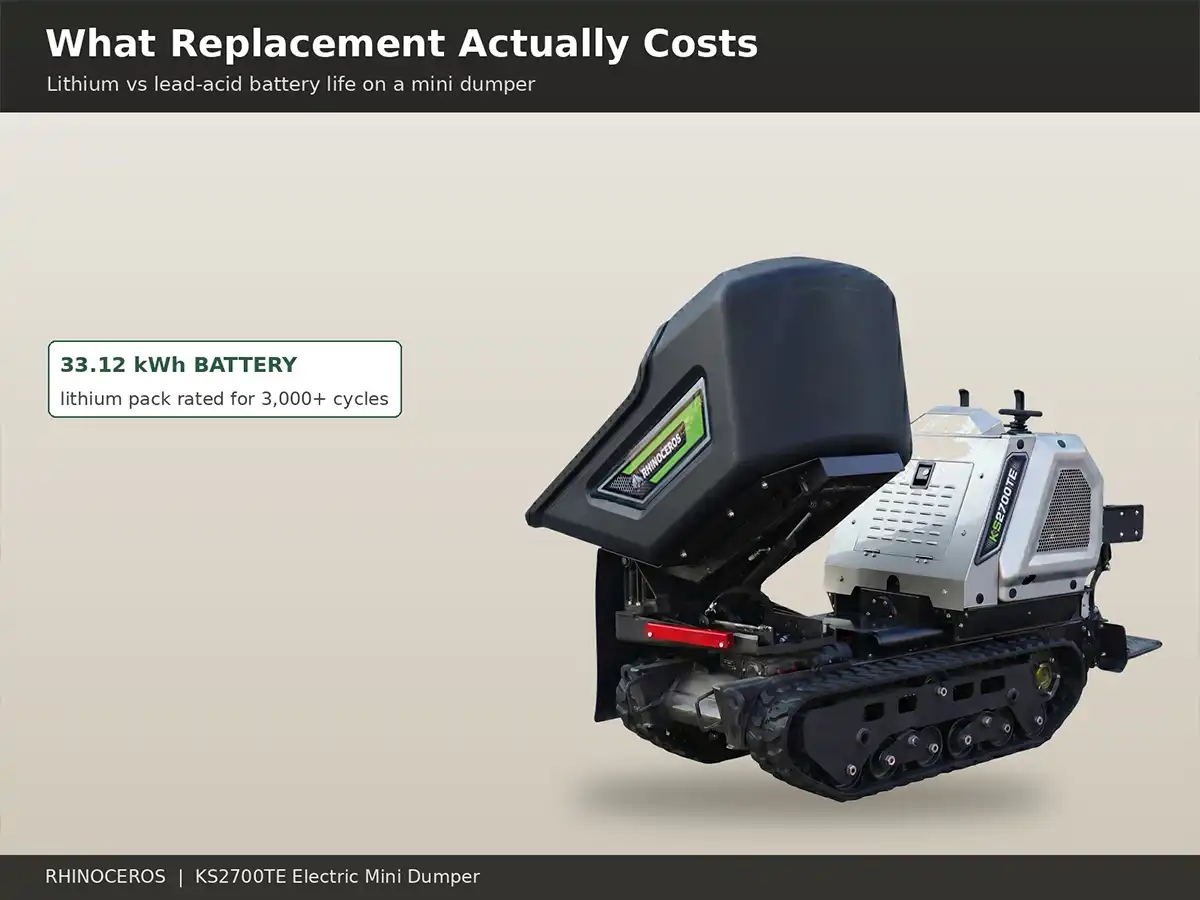
The KS2700TE runs a 72V, 33.12 kWh battery pack. Applying 2026 lithium pricing of roughly $85 to $151 per kWh gives a rough full-pack replacement estimate somewhere in the $2,800 to $5,000 range, before installation. That's a wide range, since exact pricing depends on chemistry grade, supplier, and installation labor, and it's an estimate based on general market pricing, not a quoted cost for a specific replacement job.
What matters more than the exact number is the timing: at 3,000 to 5,000 rated cycles, a machine cycled once per working day wouldn't approach that replacement point for roughly 8 to 12 years of daily use, which is longer than many buyers keep a piece of compact equipment before upgrading or reselling it entirely.
Why "battery dies" is the wrong mental model
Lithium batteries don't fail suddenly the way that phrase implies. Usable capacity degrades gradually over thousands of cycles, meaning a battery nearing the end of its rated life still holds a meaningful charge, just less than it did new. A machine's practical runtime shortens gradually over years, giving an owner ample warning and planning time before a replacement is genuinely necessary, rather than an unexpected dead-battery event.
What actually shortens battery life faster than expected
Repeated deep discharges, running the battery to empty regularly rather than charging before it's fully depleted
Extended storage at very low charge, particularly over an off-season without periodic top-ups
Extreme temperature exposure, both sustained heat and sustained cold affect battery chemistry over time
Using a non-matched or basic charger instead of the system designed for the specific battery chemistry
None of these are exotic risks. They're routine habits that are easy to get wrong without realizing it, and avoiding them costs nothing beyond a small amount of attention to charging routine.
Five habits that get a battery closer to its rated lifespan
Charge before fully depleting, rather than habitually running the battery down to empty
Keep the machine at a moderate charge level during extended idle periods rather than leaving it fully drained
Use the manufacturer-specified charger rather than a generic or mismatched alternative
Avoid unnecessary exposure to extreme heat, parking in shade where practical during hot weather
Follow any manufacturer guidance on periodic maintenance charging during off-season storage
When lead-acid still makes sense despite the shorter lifespan
Lithium isn't automatically the right choice for every buyer, even with its longevity advantage. Lead-acid's lower upfront cost can make sense for lighter, occasional use where the machine won't come close to cycling through even a lead-acid battery's shorter rated life before the owner upgrades or resells. The lithium advantage compounds specifically with frequency of use, which is why the calculation should be run against actual expected usage, not lithium's specs in isolation.
How this affects resale value
A used electric mini dumper's battery condition is one of the first things a buyer should ask about, similar to how engine hours matter on a diesel machine. A machine with a documented, well-maintained lithium battery well within its cycle life is a straightforward resale case. One with an aging lead-acid pack nearing replacement should factor that upcoming cost into the negotiated price, since a buyer inheriting a battery near end-of-life is effectively inheriting a near-term expense.
Why golf cart and forklift battery data is the closest available reference
It's worth being upfront about where the pricing and lifespan figures in this article actually come from. There isn't a large public dataset specifically for mini dumper battery replacement costs, since the category is smaller and newer than golf carts or forklifts. The lithium versus lead-acid economics, cost per kWh, cycle life, degradation pattern, are consistent across battery chemistry regardless of what vehicle it powers, which is why figures drawn from the broader small-scale lithium battery market, including golf cart and light material-handling equipment, translate reasonably well to a mini dumper's battery pack. The absolute dollar figures should be treated as a directional estimate rather than a precise quote, but the underlying chemistry economics driving those figures apply the same way to any LiFePO4 pack in this general capacity range.
Capacity context: how a mini dumper battery compares
For scale, the KS2700TE's 33.12 kWh pack sits in a similar general range to a mid-size golf cart fleet battery or a small material-handling battery, well below a full electric forklift's pack, which often runs into the tens of kilowatt-hours at the high end for heavy multi-shift use. That comparable scale is part of why cross-category lithium pricing data is a reasonable stand-in for mini dumper-specific figures that don't yet exist in the same public volume.
Charging speed and its indirect effect on battery life
Faster charging is often marketed as a pure convenience feature, but charging speed and battery longevity are connected in ways worth understanding. Consistently fast-charging at the highest rate a battery supports generates more heat and stress per cycle than a moderate charging rate does, which can very slightly accelerate long-term degradation compared with slower, more moderate charging. This isn't a reason to avoid fast charging when it's genuinely needed, a tight turnaround between shifts is a legitimate use case, but a habit of fast-charging by default when a slower overnight charge would work just as well trades a small amount of long-term battery life for convenience that isn't always necessary.
What a documented charging routine looks like in practice
Translating the habits above into an actual daily routine: charge at the end of a working day rather than waiting until the battery is nearly empty, use the machine's designated charger rather than a substitute, and avoid leaving the machine on a charger indefinitely once it reaches full charge if the charging system doesn't automatically manage trickle charging. For seasonal storage, checking charge level monthly and topping up to a moderate level, rather than leaving the machine fully depleted or fully charged for months, is the single habit most consistently cited across battery longevity guidance regardless of the specific equipment type involved.
Confirm battery specifications for your specific model
Battery chemistry, capacity, and rated cycle life vary across the Rhinoceros electric mini dumper lineup. Confirm the exact battery specification, warranty terms, and expected lifespan for the specific model being considered directly with Rhinoceros, since this article reflects general battery technology principles rather than a confirmed spec sheet for every model.
Frequently asked questions
Is a lithium battery worth the higher upfront cost for occasional use?
Less clearly so than for daily use, since the advantage compounds with cycle frequency; a machine used only occasionally may not need lithium's extended cycle life to reach its practical service life.
Can a lead-acid battery be upgraded to lithium later?
Sometimes, though it typically requires a compatible charging system and wiring changes, which adds cost beyond the battery itself; confirm compatibility with the manufacturer before assuming a straightforward swap.
Does cold weather permanently damage a lithium battery?
Sustained extreme cold can affect performance and accelerate long-term degradation, but occasional cold exposure isn't typically catastrophic; proper storage habits matter more than any single cold day.
How do I know when a battery is actually nearing replacement?
Gradually shortening runtime per charge over time is the main practical indicator, since degradation is progressive rather than sudden.
Is battery replacement covered under a typical equipment warranty?
Warranty terms vary by manufacturer and battery type; confirm specific coverage directly with Rhinoceros rather than assuming standard equipment warranty terms apply.
Does a bigger battery capacity always mean a better machine?
Not necessarily. Battery capacity should match actual runtime needs; a larger pack than needed adds cost and weight without proportional practical benefit.
Battery cost and lifespan figures reflect general 2026 small-scale lithium and lead-acid market data, not a confirmed quote for any specific Rhinoceros model or replacement service. Confirm current battery specifications directly with Rhinoceros.