 中文
 Español
 Francés
 Русский
 Português
 العربية
 Deutsch
 Italiano
 한국인
 Melayu
 ไทย
 Việt
 bahasa Indonesia
 қазақ
 Nederlands
 Ελληνικά
 Magyar
 čeština
 Suomalainen
 Filipino
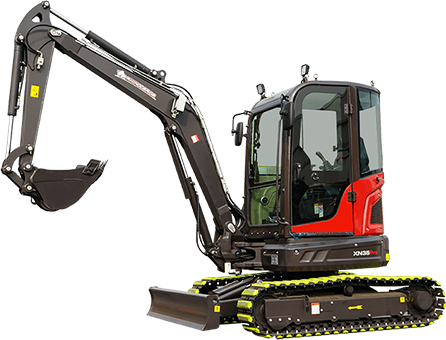
Long-reach arm + long track: reaching further, giving up what
Long-reach arm + long track: reaching further, giving up what
Our spec sheet lists a long-reach arm and long track. Here is exactly what each one trades away to get that extra reach, depth, and stability, and when the trade is worth it.
The real spec this article explains
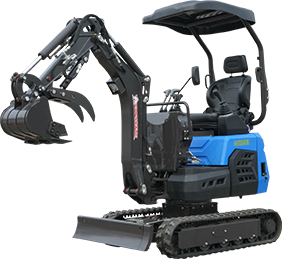
Our XN13 mini excavator page lists a long-reach arm and long track among its features. These two specs are directly connected to a number we have written about separately: a maximum digging depth of 2,020mm on a 1.3-ton machine. This article explains the mechanism behind that depth, and the real engineering cost that makes it possible.
Part one: what a longer arm trades away
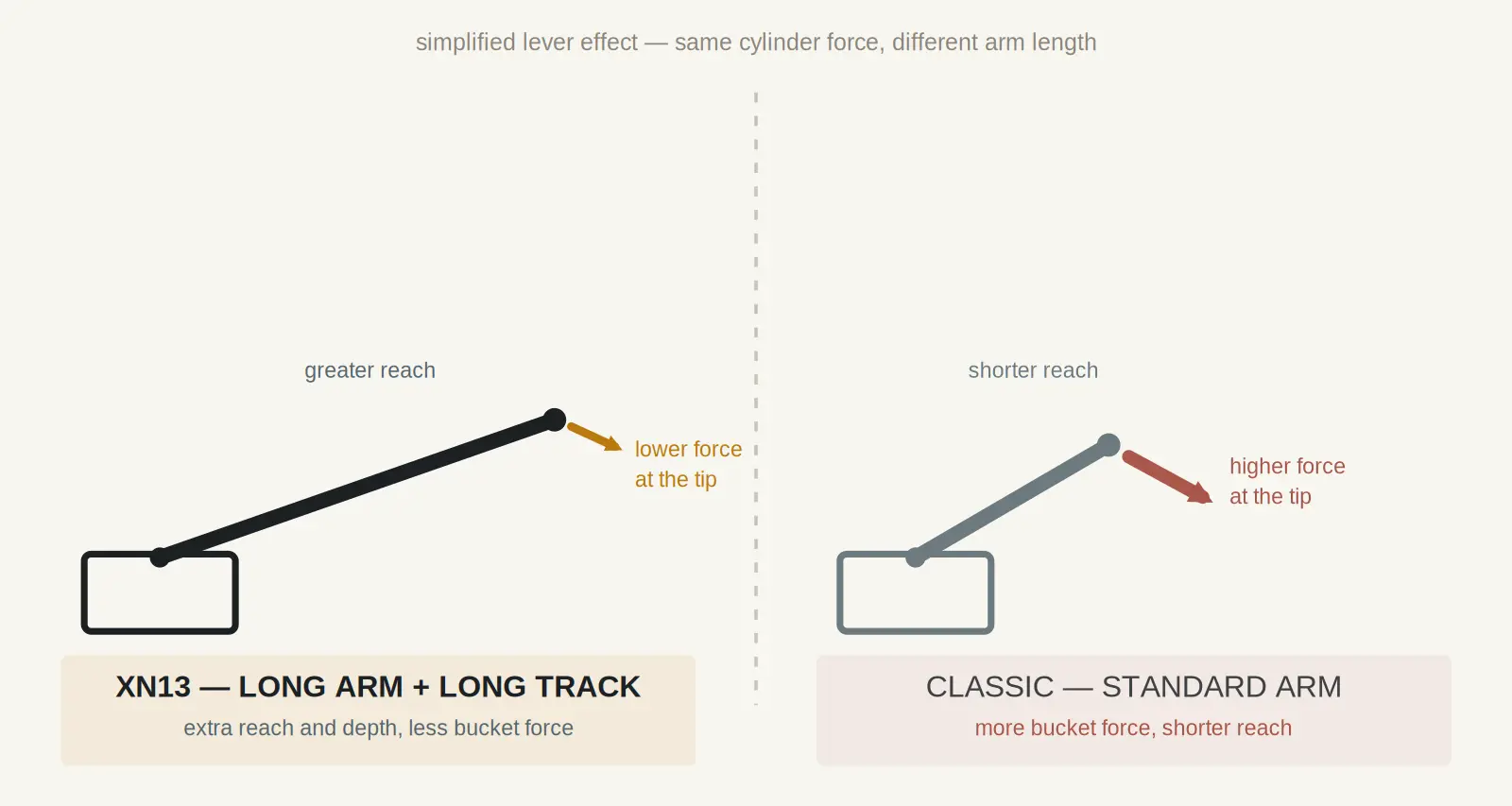
An excavator's arm (also called the stick) is driven by a hydraulic cylinder that pulls it toward the machine, the motion that generates digging force. That cylinder produces a fixed amount of force. What changes with arm length is leverage.
The lever effect, in plain terms
Industry engineering explanations of excavator arm geometry describe an inverse relationship: as arm length and reach increase, the force available at the bucket typically decreases, because the same cylinder force is being applied through a longer lever. One industry source frames the trade directly: short arms mean more power but less reach; long arms mean more reach but less power. A separate technical explanation notes that lengthening the arm to add reach commonly costs 5 to 10% of breakout force on specific configurations, with the exact loss depending on the specific geometry involved.
What this actually costs you on site
Lower breakout force. Harder, more compacted material takes more passes or more effort to break through at full reach than it would with a shorter arm.
Reduced lift capacity. Industry sources note that because the load sits further from the machine's center of gravity, a long arm reduces how much weight can be lifted safely compared with a short arm of the same class.
Slower cycle times at extension. A John Deere product consultant, quoted in trade press coverage of this exact trade-off, notes that reduced arm force "could take longer to load the bucket," meaning productivity on tough material can drop even though reach has increased.
Reduced stability at full reach. The further the load sits from the machine, the more leverage it exerts against the machine's own stability, which is why operating technique matters more at full extension than it does working close to the machine.
Part two: what a longer track trades away
Track length is a separate question from arm length, and it solves a separate problem: keeping the machine stable while that longer arm is reaching out.
What a longer track gives you
Industry documentation on undercarriage design is consistent: a longer track frame distributes the machine's weight and traction across more ground contact, directly improving front-to-back stability, the exact direction a long arm puts the most strain on when fully extended. Engineering comparisons of undercarriage length also note that a longer wheelbase improves traction across varied and loose ground, reducing the risk of slipping during digging.
What a longer track costs you
Length and maneuverability pull in opposite directions. A longer undercarriage increases the machine's overall footprint, and industry sources on tight-access excavator design describe a longer wheelbase as working against the kind of pivot-in-place agility that makes mini excavators useful in confined yards and jobsites in the first place. This is a separate concern from the machine's width, which our gate and narrow-access guide covers; a longer track mainly affects how much room the machine needs to manoeuvre once it is through a gate, not whether it fits through one.
Side by side
| XN13 — long arm + long track | Classic — standard arm + standard track | |
|---|---|---|
| Digging depth and reach | Greater | Standard for the class |
| Breakout force at full extension | Reduced, typically 5–10% on comparable configurations | Higher |
| Lift capacity | Reduced | Higher |
| Front-to-back stability | Improved by the longer track | Standard |
| Manoeuvring footprint / pivot agility | Larger footprint to manage | Tighter |
| Best suited work | Trenching, basement, deep utility digging | Mass excavation, hard or compacted material |
What this does not mean
A long arm and long track are not an upgrade over a standard configuration in every sense. If your work is mostly breaking hard, compacted ground, or you need maximum lift capacity for placing material, a shorter arm configuration genuinely out-performs a long-reach one on force and productivity, and that is not a limitation of the shorter design, it is what that design is built for. The XN13's configuration is a specific answer to a specific question: reach and depth in a compact frame, not raw breakout force.
What to ask before you compare two mini excavators
What is the actual breakout force at full arm extension, not just at the arm's closest position to the machine?
What is the rated lift capacity at maximum reach, versus lift capacity close to the machine?
How much manoeuvring space does the track length require to pivot or turn on your actual site?
Is your work mostly deep, narrow digging, or mass excavation in harder material? The answer should point you toward a long-reach or a short-arm configuration respectively.
Send us your typical digging depth, ground conditions, and site access through our inquiry form, and we can confirm whether the XN13's configuration fits your work. You can review the full specification on the XN13 product page.
Frequently asked questions
Does a longer arm reduce the XN13's digging power?
Yes, at full extension. The same cylinder force applied through a longer lever produces less breakout force at the bucket, a well-documented trade-off across the excavator industry, not specific to any one brand.
How much breakout force is typically lost with a longer arm?
Industry sources cite roughly 5 to 10% on specific comparable configurations, though the exact figure depends on the specific arm geometry involved.
Why does the XN13 also have a long track if the trade-off is about the arm?
The long track addresses a different problem: it improves front-to-back stability, which matters most exactly when the long arm is extended and placing more leverage on the machine.
Does a longer track make the machine harder to manoeuvre?
It can increase the overall footprint needed to pivot or turn compared with a shorter undercarriage, which is a separate consideration from the machine's width and gate access.
Is a long-reach configuration the wrong choice for hard ground?
For mass excavation in hard, compacted material, a shorter arm configuration generally provides more usable breakout force and lift capacity. Long-reach configurations are built for depth and reach, not maximum force.
Who typically benefits most from the XN13's long-reach configuration?
Contractors doing basement, foundation, or utility trenching work, where reach and digging depth matter more than raw breakout force, according to trade press interviews with excavator product specialists.
Feature availability varies by model and configuration; confirm current specifications directly with Rhinoceros before purchase. Comparisons of arm and track geometry describe general mini excavator engineering principles reported across the industry and are not claims made about specific competitor products by Rhinoceros.