 中文
 Español
 Francés
 Русский
 Português
 العربية
 Deutsch
 Italiano
 한국인
 Melayu
 ไทย
 Việt
 bahasa Indonesia
 қазақ
 Nederlands
 Ελληνικά
 Magyar
 čeština
 Suomalainen
 Filipino
EPA certification: what it actually means for a US buyer
EPA certification: what it actually means for a US buyer
Our spec sheet lists EPA certification alongside CE. Here is what that actually requires, how it differs structurally from CE, and why this specific engine class doesn't need DEF.
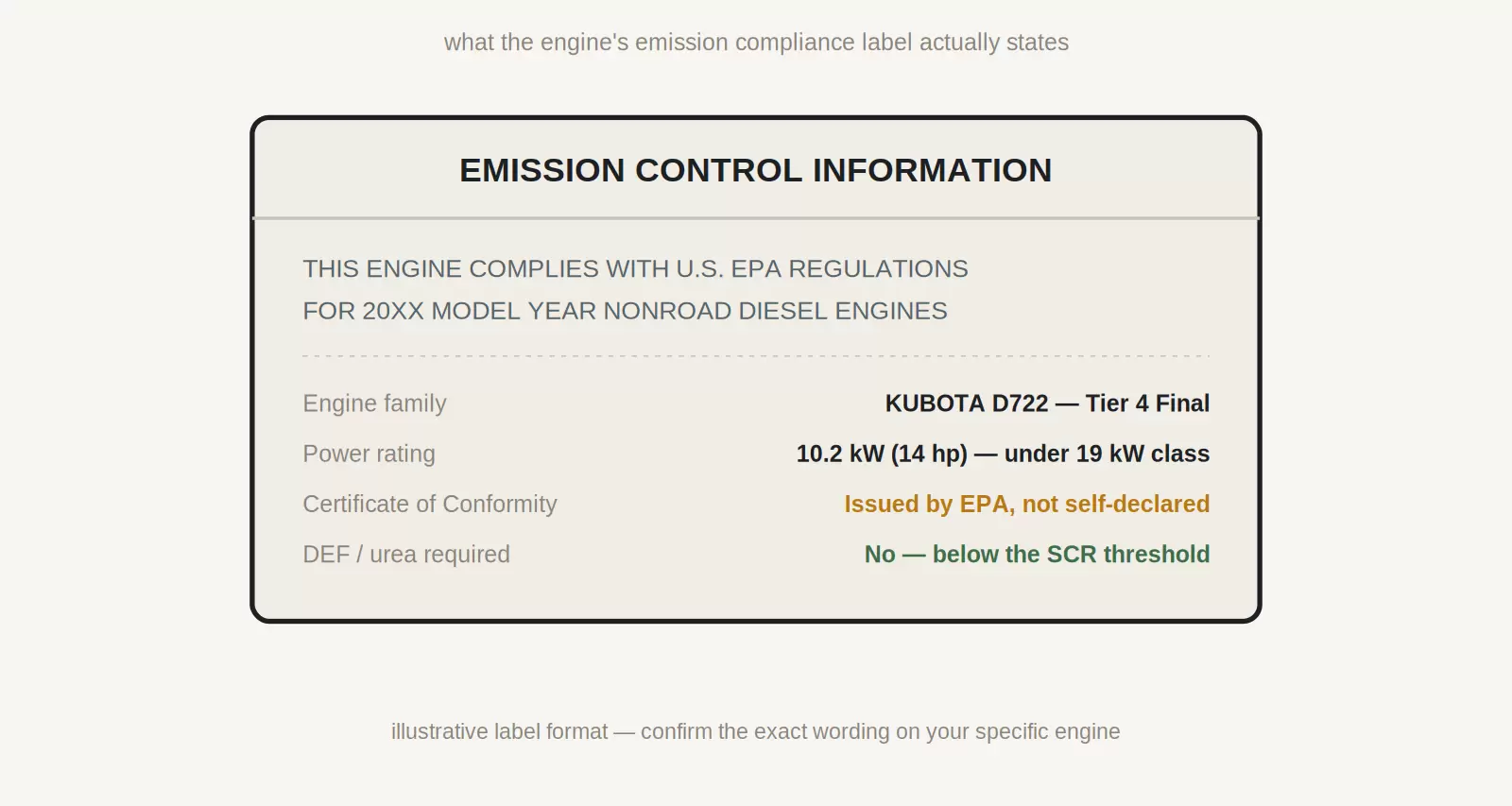
The real claim this article explains
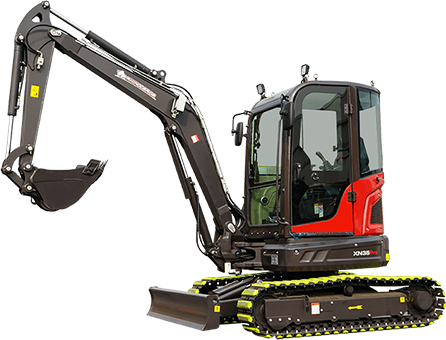
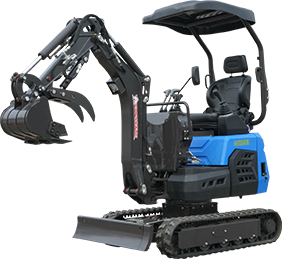
Our XN13 mini excavator page lists EPA certification alongside CE. We have written separately about what CE certification actually requires on another model. EPA certification is a different system, under different law, with a different structure, and it is worth understanding on its own terms rather than assuming it works the same way.
What EPA certification legally requires
Under the US Clean Air Act, nonroad diesel engines sold or imported into the United States are regulated under 40 CFR Part 1039, the EPA's Non-Road Diesel Engine Regulations. Industry compliance guidance describes the requirement plainly: every qualifying engine must carry an EPA Certificate of Conformity, a document issued by the EPA itself, confirming the engine meets the applicable emissions tier for its power rating.
Which standard actually applies to the XN13's engine
Our XN13 is powered by a Kubota D722 engine rated at 10.2 kW (14 hp). Under EPA's power-based classification system, that places it in the smallest regulated nonroad diesel category, engines rated under 19 kW (under 25 hp). Industry sourcing on this exact engine confirms the Kubota D722 is EPA Tier 4 Final certified, the current and most stringent US standard for nonroad diesel engines, in effect since 2015 for the power classes used in most mini excavators.
What Tier 4 Final actually limits
Tier 4 Final sets specific numeric limits on particulate matter, nitrogen oxides, and hydrocarbons, tightened substantially from earlier tiers. Technical documentation on the standard cites limits such as 0.02 g/hp-hr for particulate matter on most engine sizes and roughly 0.40 g/hp-hr for nitrogen oxides on mid-size nonroad engines, values that effectively require modern emissions control technology to achieve, compared with older, unregulated or lightly regulated engines.
Why this specific engine class does not need DEF
This is a detail worth knowing before you buy, because it affects day-to-day operating cost. Industry guidance on Tier 4 engines is specific: diesel exhaust fluid (DEF, also called urea) is required only on engines that use selective catalytic reduction (SCR) technology to meet NOx limits, and that is generally engines above roughly 75 hp. At 14 hp, the XN13's engine sits well below that threshold. In practice, this means no DEF tank to monitor, no urea to buy and top up, and no risk of a DEF-related engine derate if the fluid runs low, a genuine ongoing cost and maintenance item on larger Tier 4 Final machines that simply does not apply here.
Side by side
| EPA certification | CE certification (most machinery) | |
|---|---|---|
| Who issues it | The EPA itself, after reviewing test data | Often the manufacturer's own declaration |
| Governing law | Clean Air Act, 40 CFR Part 1039 | EU Machinery Directive 2006/42/EC |
| What it specifically governs | Engine exhaust emissions | Broader machinery health and safety requirements |
| Verifiable document | EPA Certificate of Conformity | EU Declaration of Conformity |
What to ask for, and how to verify it
Ask for the engine's EPA emission control label information and, where available, the Certificate of Conformity reference for that specific engine family. A supplier who can show you this is describing a real, government-reviewed compliance status, not a marketing phrase. Be cautious of any supplier offering a "new" machine with an older, Tier 3 or earlier engine for US sale: industry compliance guidance notes these older engines generally cannot be newly manufactured or imported for sale in the US, which makes an EPA-compliant engine the only legitimate option for a new machine regardless of price.
What this does not mean
EPA certification addresses engine exhaust emissions specifically. It does not certify the machine's general build quality, structural safety, or mechanical durability, those are separate questions covered by other parts of a buying decision. It also does not mean every Tier 4 Final engine behaves identically: power class, aftertreatment technology, and maintenance requirements still vary across engines even within the same tier.
Questions to ask before you buy
Can you provide the engine's EPA emission control label details and Certificate of Conformity reference?
What power class is the engine rated in, and does that class require DEF?
Is the specific engine family currently in production, or an older engine being offered on a "new" machine?
Ask us directly through our inquiry form for the XN13's emissions documentation. You can review the full specification on the XN13 product page.
Frequently asked questions
Is EPA certification the same kind of process as CE certification?
Not structurally. EPA certification results in a Certificate of Conformity issued directly by the EPA after reviewing emissions test data. CE marking, for most machinery, is often a manufacturer's own declaration.
Which EPA emissions tier applies to the XN13?
Its Kubota D722 engine, rated at 10.2 kW (14 hp), falls in EPA's smallest nonroad diesel category, under 19 kW, and is Tier 4 Final certified, the current US standard.
Does the XN13 require DEF (diesel exhaust fluid)?
No. DEF is required only on larger engines using SCR technology, generally above roughly 75 hp. The XN13's 14 hp engine is well below that threshold.
Can a supplier legally sell a new excavator with an older, Tier 3 engine in the US?
Generally no. Industry compliance guidance states Tier 3 engines cannot be newly manufactured or imported into the US for sale, making a current Tier 4 Final engine the standard requirement for a new machine.
Does EPA certification cover anything beyond emissions?
No. It specifically addresses engine exhaust emissions under the Clean Air Act. It does not certify general build quality or mechanical safety.
How can I verify the XN13's EPA certification myself?
Ask for the engine's emission control label details and Certificate of Conformity reference, and request a copy directly from Rhinoceros.
Feature availability varies by model, configuration, and market; confirm current certification documentation directly with Rhinoceros before purchase. Regulatory information is drawn from published EPA documentation and industry compliance guidance, current as of October 2026.