 中文
 Español
 Francés
 Русский
 Português
 العربية
 Deutsch
 Italiano
 한국인
 Melayu
 ไทย
 Việt
 bahasa Indonesia
 қазақ
 Nederlands
 Ελληνικά
 Magyar
 čeština
 Suomalainen
 Filipino
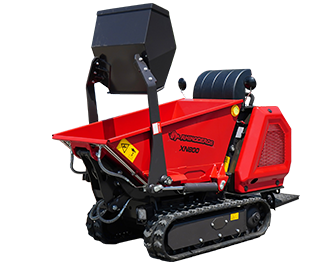
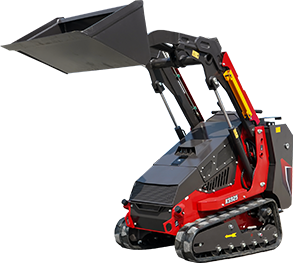
Why does the KS450E use an electric cylinder instead of hydraulics to tip the bucket?
By Justin, Product Engineer · Based on official factory specifications and mechanical engineering documentation, September 2026
TL;DR: Most mini dumpers tip the bucket with a hydraulic ram. The KS450E uses an electric cylinder instead. That means no hydraulic fluid to leak or maintain, power drawn only while the bucket is actually moving, and a simpler machine overall, at the cost of less raw force than a hydraulic system could deliver.
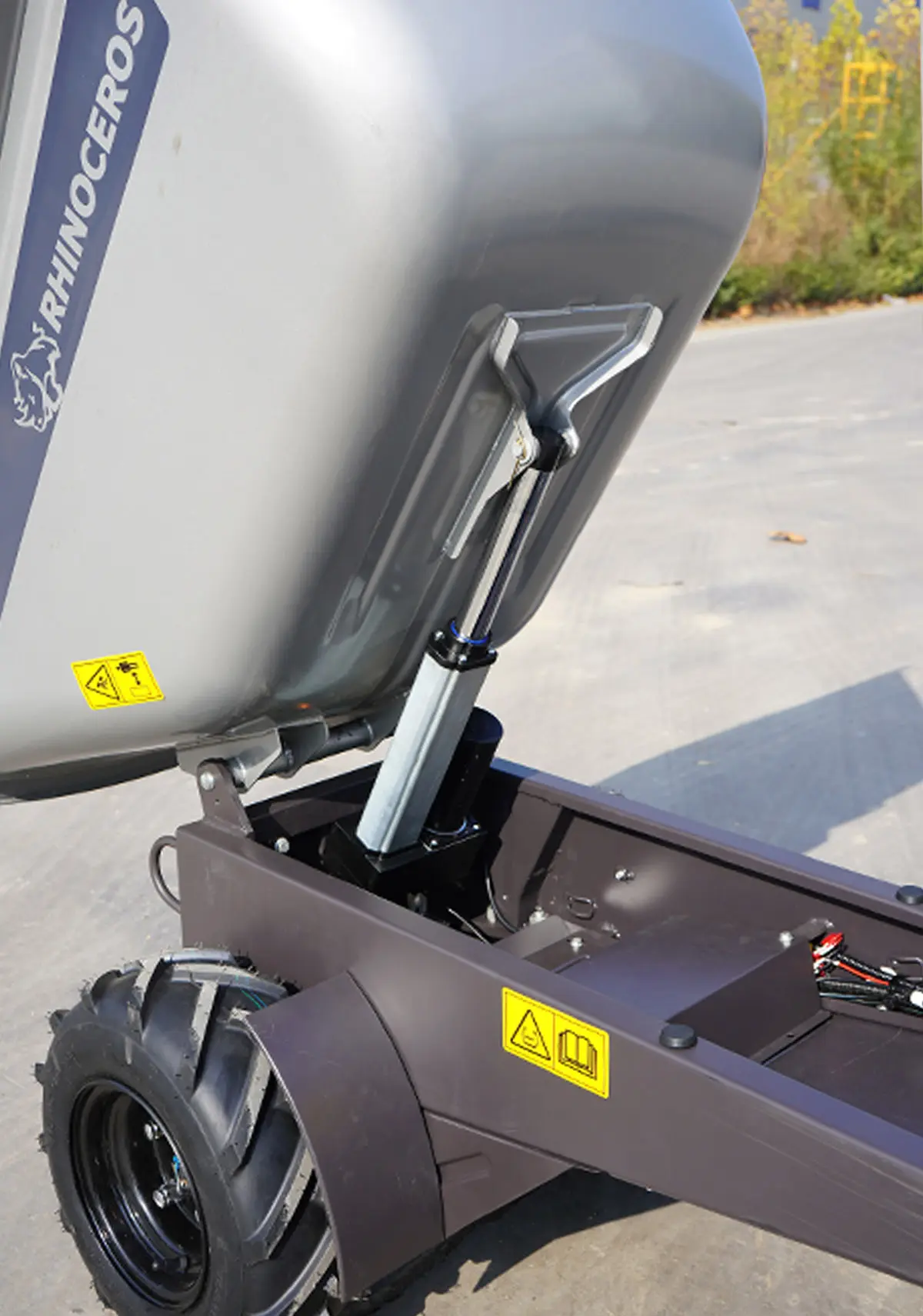
The real spec this article explains
Our official KS450E listing describes the tipping function as driven by an electric cylinder, stating this provides greater stability and reliability in operation. Most dumpers in this class, including many competing electric models, use a small hydraulic ram for the same job. The choice between the two is a real engineering decision with real trade-offs, not a cosmetic difference.
What a hydraulic cylinder needs to work
A hydraulic tipping system is not just the ram itself. It needs a pump to pressurise fluid, a reservoir to hold that fluid, hoses to carry it, and seals throughout to keep it from leaking. Engineering comparisons of the two technologies are consistent on this point: hydraulic systems have more moving parts and components, pumps, reservoirs, fluid lines, and valves, and that fluid has to be monitored and eventually replaced as part of routine maintenance. Hydraulic systems are also the dominant choice where raw force and long stroke length matter most, because they remain the most powerful actuator type for genuinely heavy-duty work.
What an electric cylinder does differently
An electric cylinder (also called an electric linear actuator) replaces the pump, reservoir, and fluid entirely with a motor and a mechanical screw drive built into the cylinder itself. Engineering sources on this comparison describe several consistent advantages for this kind of system: no fluid to leak, since there is no hydraulic fluid in the circuit at all; minimal to no routine maintenance, since there are no seals monitoring fluid pressure or filters to change; and power draw only while the actuator is actually moving, rather than a pump running continuously to maintain pressure. One detailed engineering comparison also notes that electric actuators can generate force instantaneously, where a hydraulic cylinder has to wait for pressure to build before it can move.
Why this fits a small electric machine specifically
| Factor | Hydraulic cylinder | Electric cylinder |
|---|---|---|
| Extra components needed | Pump, reservoir, hoses, seals | None beyond the motor and screw mechanism built into the cylinder |
| Leak risk | Present, inherent to any fluid system | None, no hydraulic fluid in the circuit |
| Routine maintenance | Fluid level checks, periodic fluid replacement, seal wear | Minimal to none |
| Power draw pattern | Pump often runs to maintain system pressure | Draws power only while the cylinder is actually extending or retracting |
| Best suited for | Very high force, long-stroke, heavy-duty applications | Lighter-duty, precise, maintenance-sensitive applications like a compact dumper's bucket tip |
On a battery-powered machine like the KS450E, the power-draw pattern matters more than it might on a diesel machine. Every watt spent running a hydraulic pump to maintain pressure is a watt not available for driving or working time. An electric cylinder that only draws power during the actual tipping motion, which is a small fraction of a typical work cycle, is a better match for a machine whose entire working time is budgeted against a battery charge.
What this does not mean
An electric cylinder is not simply "better" in every situation. It is not the right choice for applications needing very high force or a long stroke length, which is why larger, heavier-duty tipping mechanisms across the industry still commonly use hydraulics. For a compact mini dumper's bucket tip, where the force and stroke requirements are modest and maintenance simplicity and battery efficiency matter more, the trade-off works in the electric cylinder's favour. That is a different calculation than it would be on a much larger or heavier machine.
What to ask before you buy
What is the tipping cylinder's rated stroke and load capacity, and does it comfortably cover a full bucket load at 450kg?
Is there any routine maintenance recommended for the electric cylinder, even if less than a hydraulic equivalent?
How does the tipping speed compare to a hydraulic equivalent, since electric cylinders can behave differently in tipping speed depending on their specific motor and screw design?
Send your questions about the KS450E's tipping mechanism through our inquiry form. You can review the full specification on the KS450E product page, or compare it against our other electric dumper on our XN500E vs KS450E comparison.
Frequently asked questions
Does the KS450E use hydraulics to tip the bucket?
No. It uses an electric cylinder instead of a hydraulic ram, according to our official listing.
Is an electric cylinder weaker than a hydraulic one?
For very high-force, long-stroke applications, hydraulic systems generally deliver more raw force. For a compact dumper's bucket tip, the force and stroke needed are modest enough that this is not typically the limiting factor.
Does an electric cylinder need maintenance?
Far less than a hydraulic system. There is no fluid to check or replace and no seals to monitor for leaks, though routine inspection of any mechanical component is still good practice.
Why does this matter more on a battery-powered machine?
An electric cylinder draws power only while actually moving, rather than running a pump continuously to maintain hydraulic pressure, which preserves more of the battery's charge for driving and working time.
Can an electric cylinder leak like a hydraulic one?
No. Since there is no hydraulic fluid in the system, there is no fluid to leak.
Is this an unusual design choice?
It is less common than hydraulic tipping on dumpers generally, though electric actuators are an established, well-documented alternative across many industries for exactly the maintenance and efficiency reasons described above.
Feature availability varies by model and configuration; confirm current specifications directly with Rhinoceros before purchase. Engineering comparisons of actuator types are drawn from published mechanical engineering documentation and describe general principles, not confirmed performance figures for the KS450E unless separately provided by Rhinoceros.